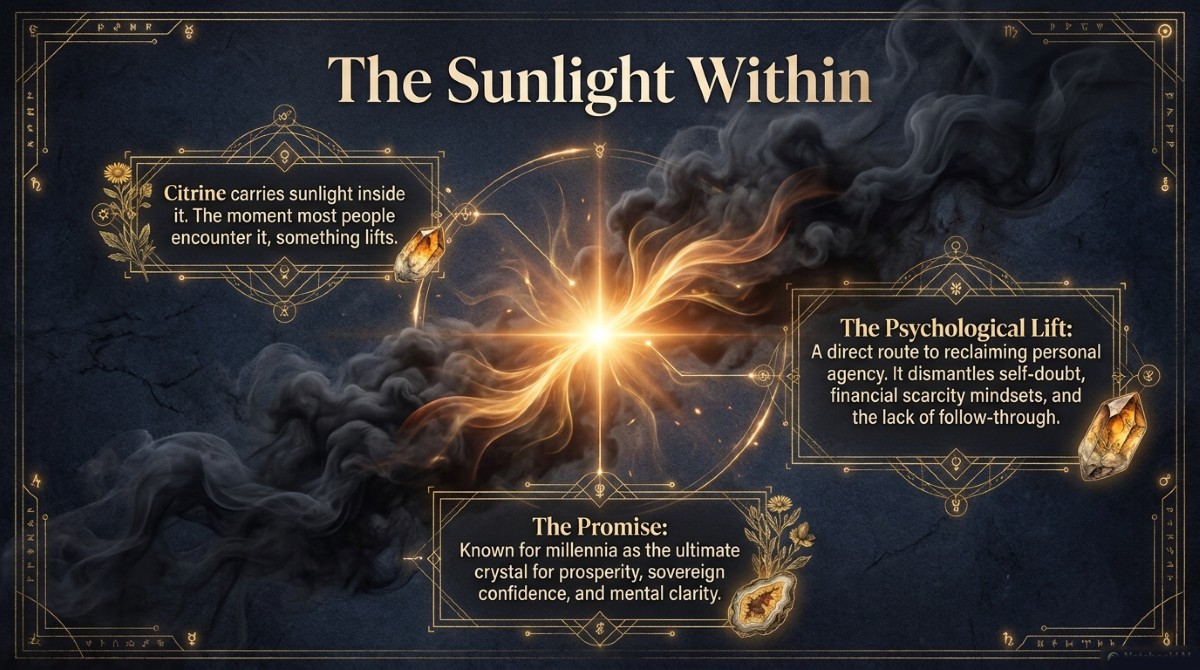
Citrine is one of the most cheerful-looking stones in the mineral world. Its warm yellow-to-amber glow seems to carry sunlight inside it, and the moment most people encounter it, something lifts. That response is not imagined. Citrine has been producing it in human beings for a very long time.
If you have been struggling with self-doubt, financial scarcity mindsets, or a lack of follow-through on your ambitions, Citrine offers a direct and powerful route to reclaiming your personal agency. Known as the “Merchant’s Stone,” it is the ultimate crystal for prosperity, confidence, and mental clarity.
But there is a side to Citrine that the abundance-and-manifestation corner of the internet rarely discusses—a shadow that emerges specifically because this stone is so effective at what it does. Like any amplifier of desire, it can turn want into need, ambition into obsession, and healthy drive into something that quietly hollows you out.
This is the complete story.
What Is Citrine? Origins, Geology, and the Uncomfortable Truth About Most of It
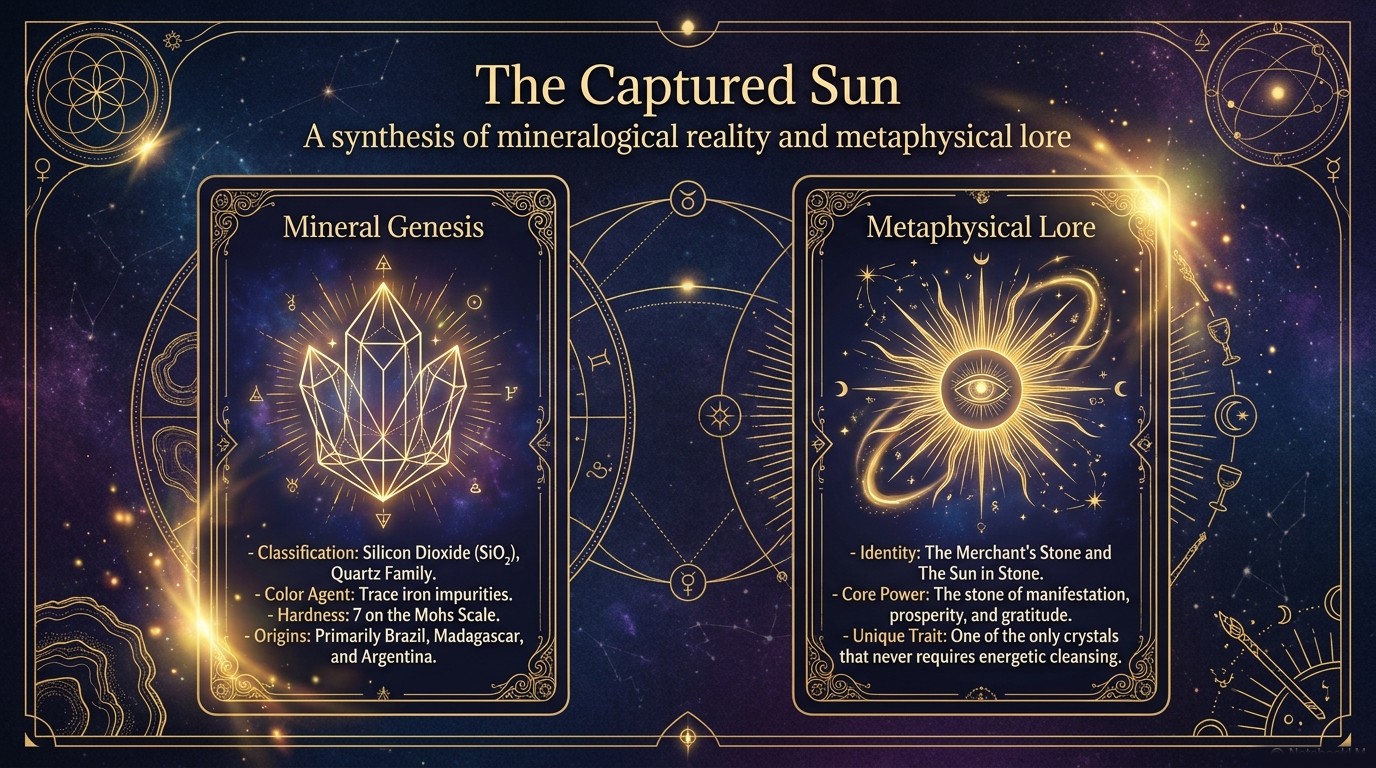
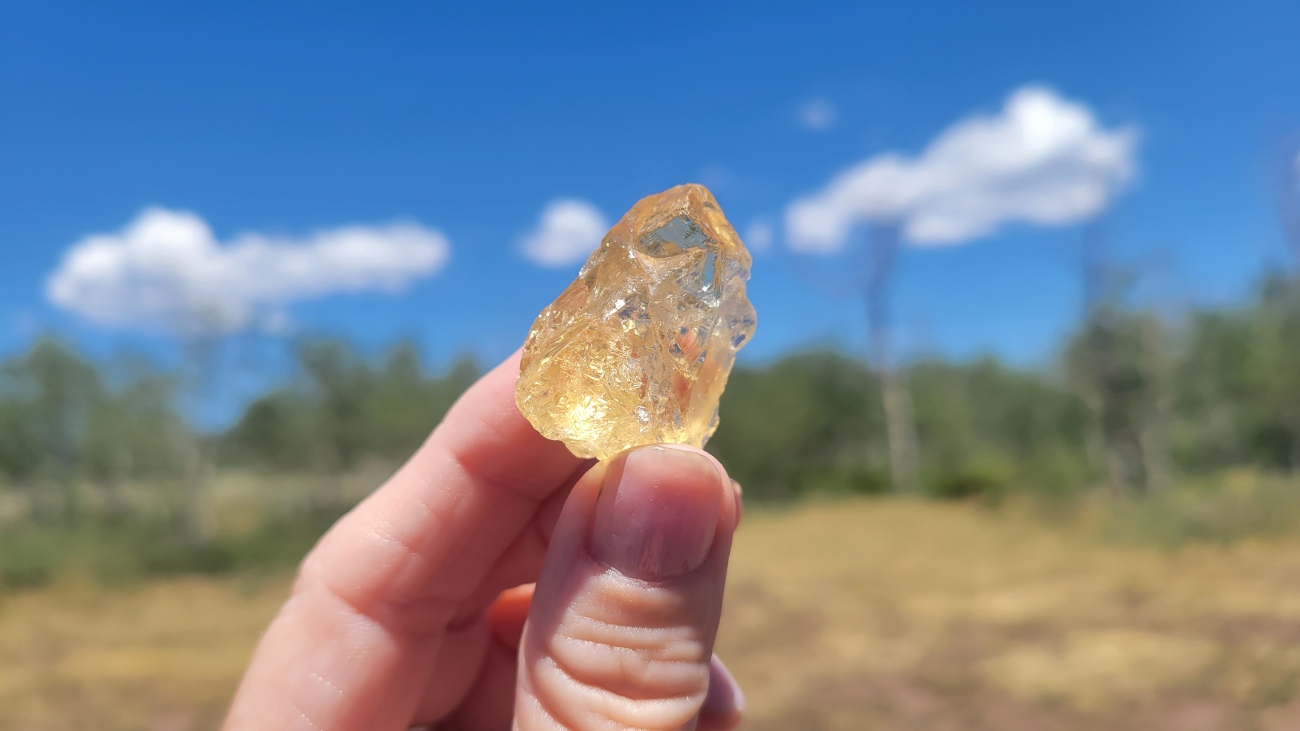
Genuine natural Citrine is a variety of crystalline quartz, colored yellow to orange-brown by trace amounts of ferric iron within the silica lattice. It forms in hydrothermal veins and pegmatites, and naturally occurring specimens are relatively rare.
The Honest Detour
Here is where intellectual honesty requires a confession that most crystal blogs avoid: geologically speaking, almost all Citrine is heat-treated. The only question is who did the heating—the earth or a human being.
Natural Citrine forms when Amethyst or Smoky Quartz is subjected to prolonged geothermal heating within the earth’s crust over millions of years. The heat oxidizes the iron impurities, shifting the color from purple or brown to yellow. Human heat-treatment does the exact same chemical thing in a laboratory kiln, compressing millions of years of geology into a few hours.
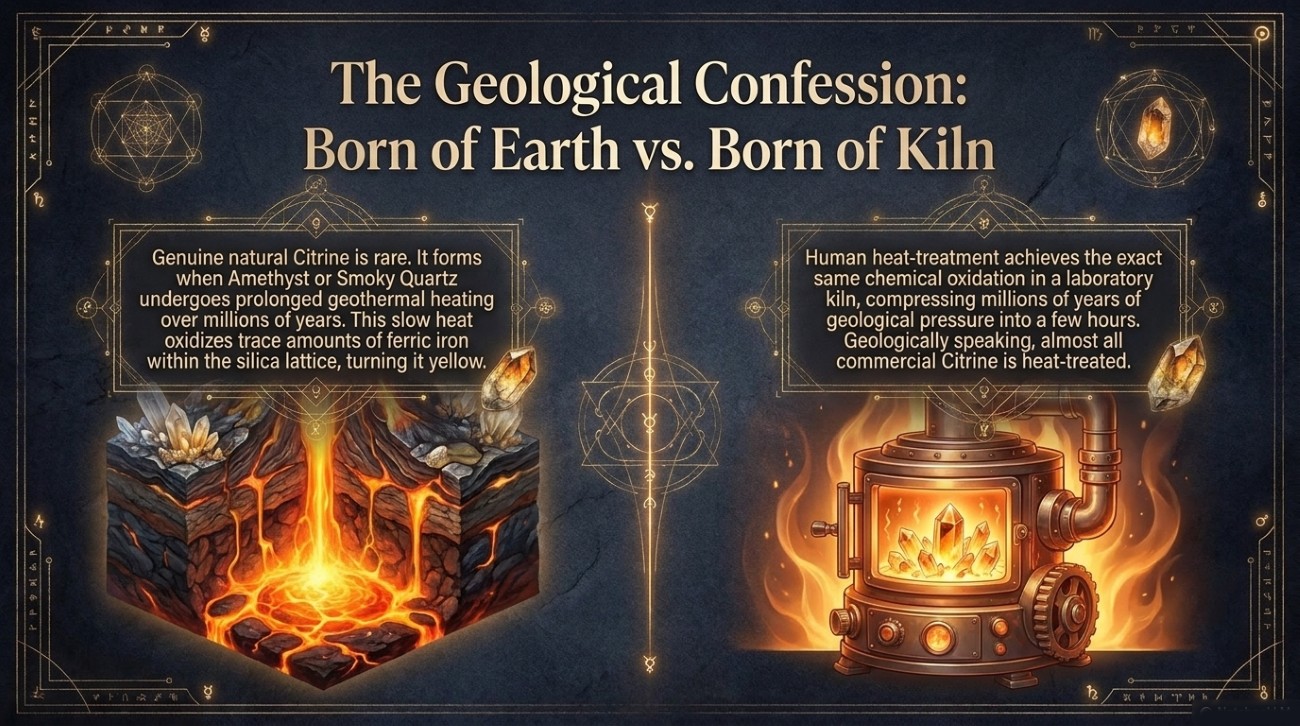
The finest natural Citrine comes from Brazil—particularly the Serra Gaúcha region—as well as Madagascar, the Democratic Republic of Congo, and smaller deposits in Russia and the United States. Natural Citrine tends toward pale, even lemon-yellow, occasionally reaching a deeper honey tone, but rarely the vivid burnt-orange color that dominates the commercial market.
So why does the distinction matter?
It matters for three reasons, and none of them are about “purity”:
- Disclosure. You deserve to know what you are buying. The treatment process is rarely disclosed at the point of sale, which is a transparency problem, not a geological one.
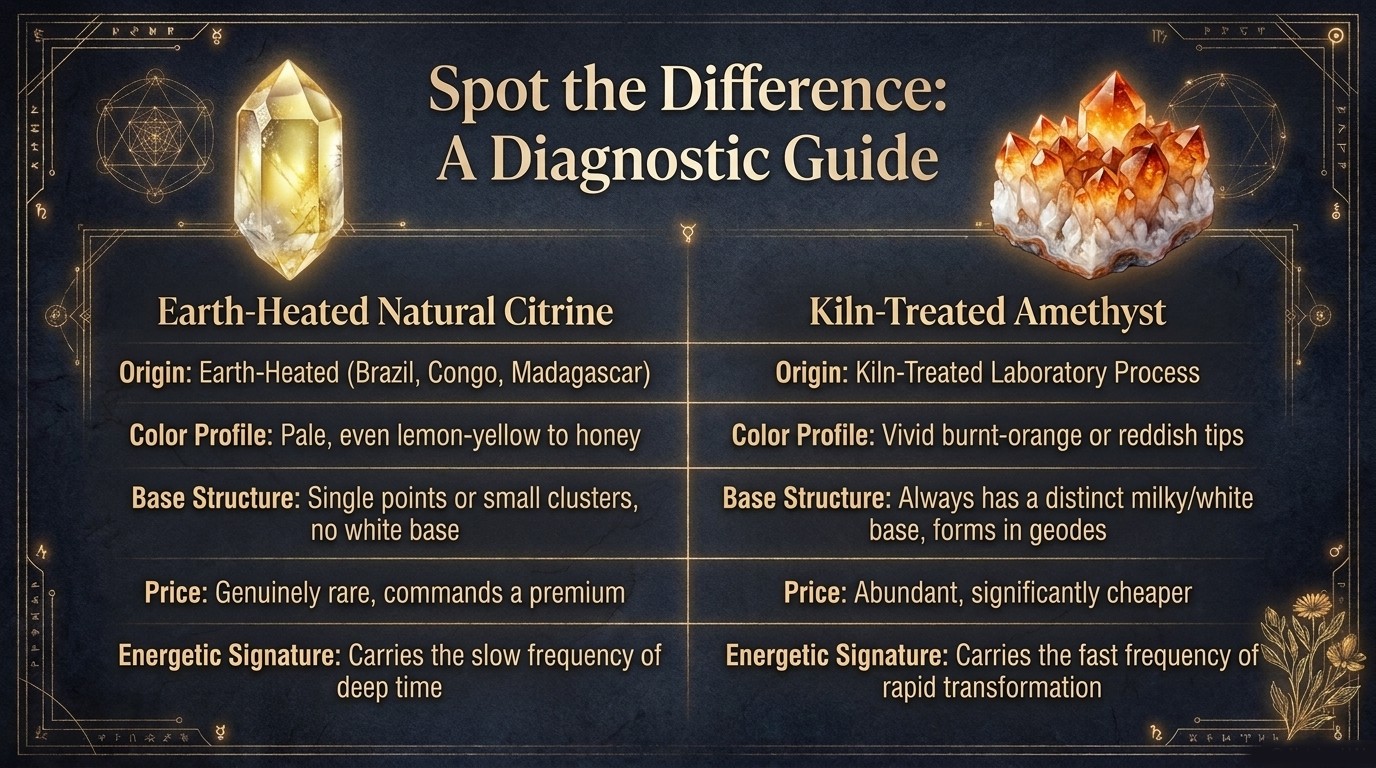
- Price. Natural, earth-heated Citrine is genuinely rare and commands a premium. Kiln-treated Amethyst is abundant and significantly cheaper. Paying natural-Citrine prices for kiln-treated material is paying for a story you didn’t receive.
- Energetic signature. Some practitioners argue that slow, ancient geological pressure produces a different vibrational resonance than rapid industrial forcing—like the difference between slow-cooked bone broth and a microwave meal. Both are chemically the same; the experiential quality is debated. If you believe the earth’s timeline matters to a stone’s energy, then natural Citrine carries the weight of deep time, while kiln-treated Citrine carries the frequency of rapid transformation.
Spot the Difference at a Glance:
- Natural, Earth-Heated Citrine: Pale, even lemon-yellow to honey; rarely has white bases; expensive; often found in single points or small clusters.
- Kiln-Treated Amethyst (sold as Citrine): Vivid burnt-orange or reddish tips; always has a distinct milky or white base; forms in cathedral/geode clusters; significantly cheaper.
The majority of what is sold as “Citrine” in the commercial market—especially the large, bright orange cathedral clusters—is kiln-treated Amethyst. If you love that bright orange cluster, buy it—just know it was born in a kiln, not a volcano. If you want the rarer, pale lemon-yellow stone that was heated by the earth itself, seek out verified Brazilian or Congolese sources and expect to pay a premium.
Whether kiln-treated material carries the same metaphysical properties as earth-heated Citrine is a question the crystal community answers differently depending on who you ask. A reasonable position is that it carries a hybrid energy—residual Amethyst qualities blended with the new structural expression. Many practitioners work with both and find both useful.
The problem is simply not knowing which one you have. If Citrine matters to you, buy from reputable mineral dealers who specify origin, and expect to pay more.
Important Care Note: Prolonged direct sunlight can fade both natural and heat-treated Citrine over time. Keep it out of harsh, continuous UV exposure to preserve its warm golden tones.
A Stone With Deep Roots: Citrine Through the Ages
Citrine’s documented relationship with humanity stretches back millennia, with distinct cultural footprints across the globe.
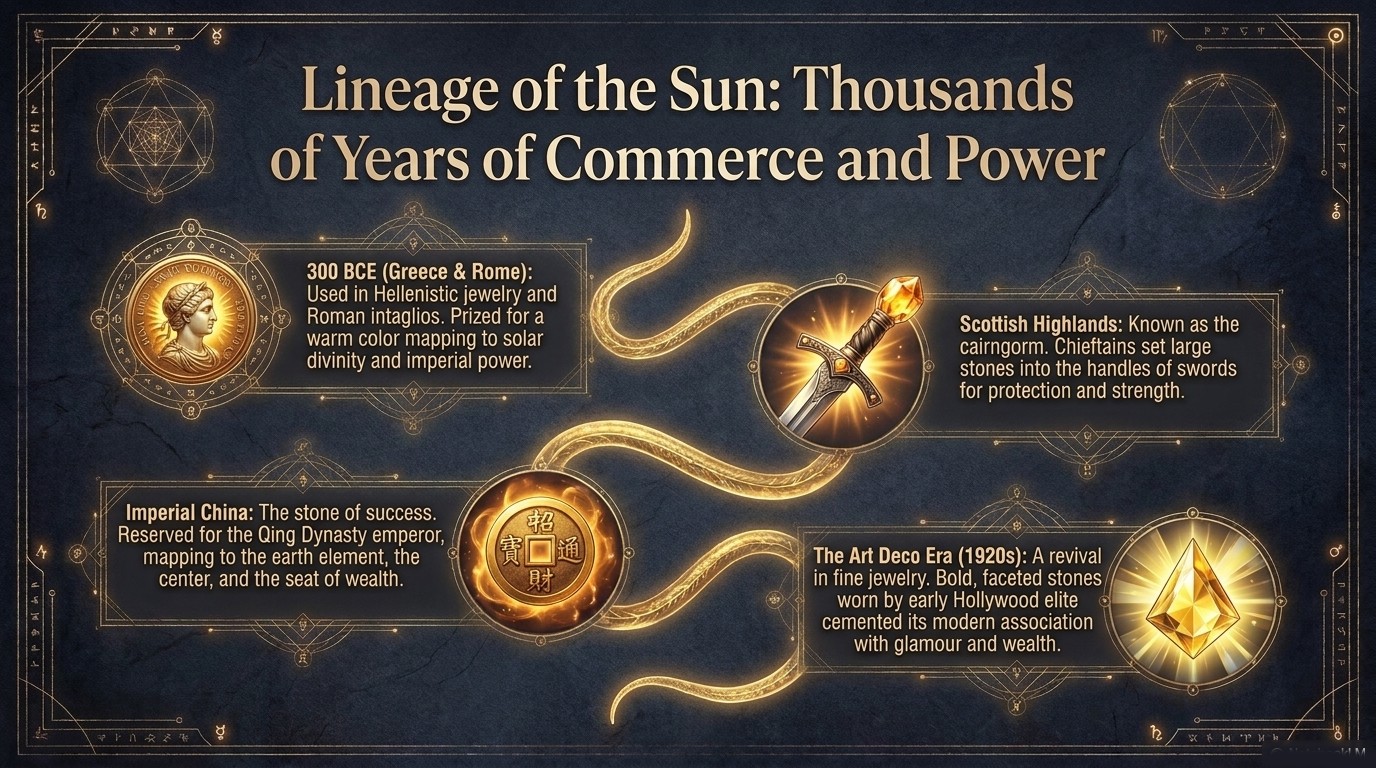
Ancient Greece and Rome: Citrine’s documented history stretches back to at least 300 BCE, when it was used in Greece during the Hellenistic period as a decorative gemstone in jewelry and carvings. The Romans followed—Citrine intaglios (engraved gemstones used as seals) and cabochons appear consistently in Roman archaeological finds through the first and second centuries CE, prized for their warm golden color at a time when yellow was strongly associated with solar divinity and imperial power.
Scotland and the Highlands: Scotland has a particularly rich relationship with Citrine, where it was known as the cairngorm—named for the Cairngorm mountain range where smoky and yellowish quartz varieties were found. Strictly speaking, traditional Scottish ‘Cairngorm’ leaned toward the smoky brown-yellow spectrum, but the lighter golden material found in the region blurred the line. Highland chieftains wore large Citrine brooches as symbols of status and power, and set the stone into the handles of daggers and swords (the traditional sgian-dubh and dirk), believing it brought protection and strength to the bearer.
Imperial China: In China, Citrine has historically been called the stone of success and associated with the imperial yellow that was reserved exclusively for the emperor during the Qing Dynasty. Yellow in Chinese metaphysics maps to the earth element, the center, the seat of wealth and authority. Mandarins wore Citrine to amplify their status and mental clarity.
The Art Deco Era: During the 1920s and 1930s, Citrine experienced a significant revival in fine jewelry. The bold geometric aesthetic of the era suited Citrine’s strong color and clarity, and large faceted stones appeared in pieces worn by Hollywood’s early elite. Greta Garbo and Joan Crawford were photographed wearing substantial Citrine pieces. This was the era that cemented Citrine’s popular association with glamour, wealth, and success—associations that flowed directly into the metaphysical framing the stone carries today.
The modern crystal market subsequently built on these historical foundations and gave Citrine its now-ubiquitous title: The Merchant’s Stone.
The Chakras, Astrology, and Elements
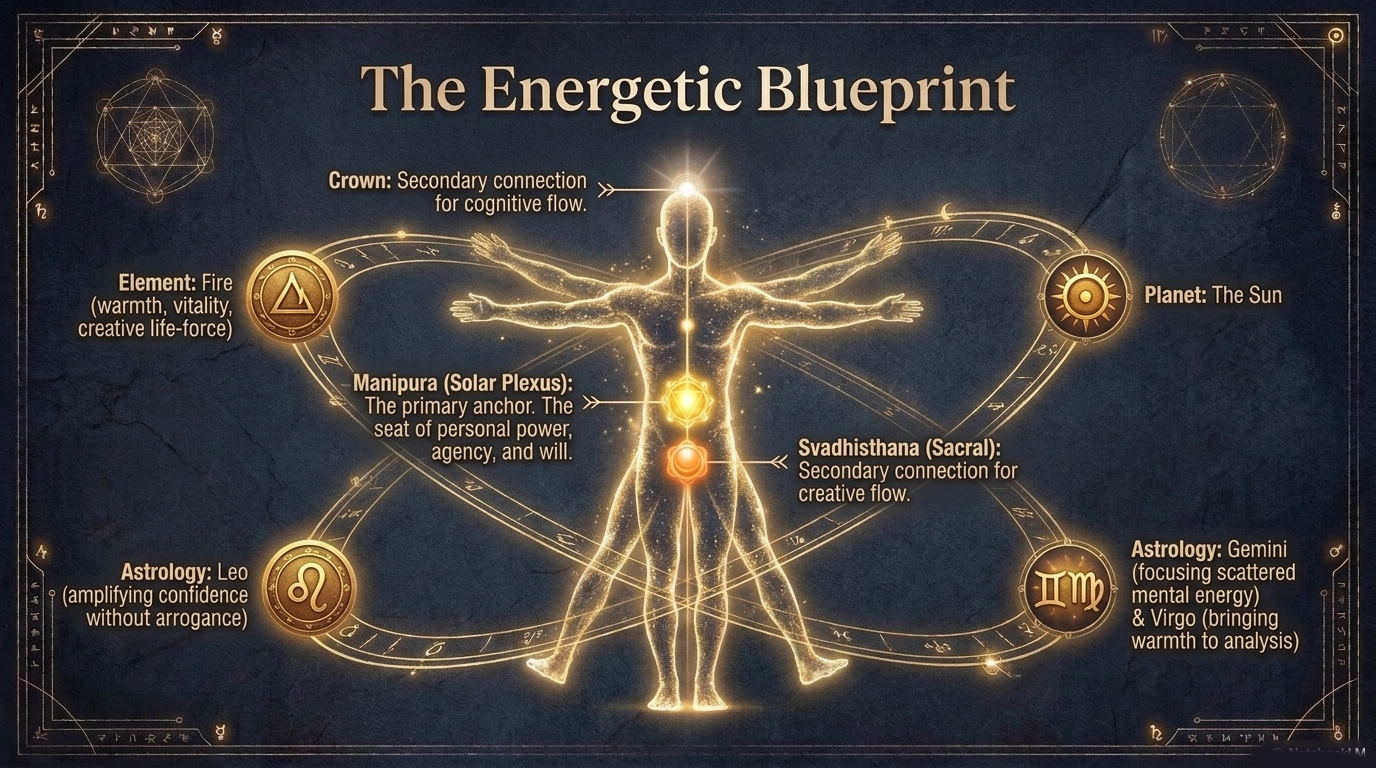
Chakra Alignment: Citrine is anchored primarily in the Solar Plexus Chakra (Manipura) and the Sacral Chakra (Svadhisthana), with a secondary connection to the Crown Chakra in some traditions. The solar plexus is the energy center of personal power, will, and identity—the place where a person’s sense of agency lives. This is the core of what Citrine works on.
Astrology: Citrine is particularly beneficial for Leo (amplifying their natural confidence without arrogance), Gemini (helping them focus scattered mental energy into actionable plans), and Virgo (bringing warmth and optimism to their analytical nature). However, it is safe and effective for any sign needing a confidence boost.
Element and Planet: Citrine is deeply bound to the element of Fire and the expansive energy of the Sun, channeling warmth, vitality, and creative life-force.
The Metaphysical Profile: What Practitioners Claim and Why
Citrine is most consistently associated with three things: abundance, personal will, and mental clarity.
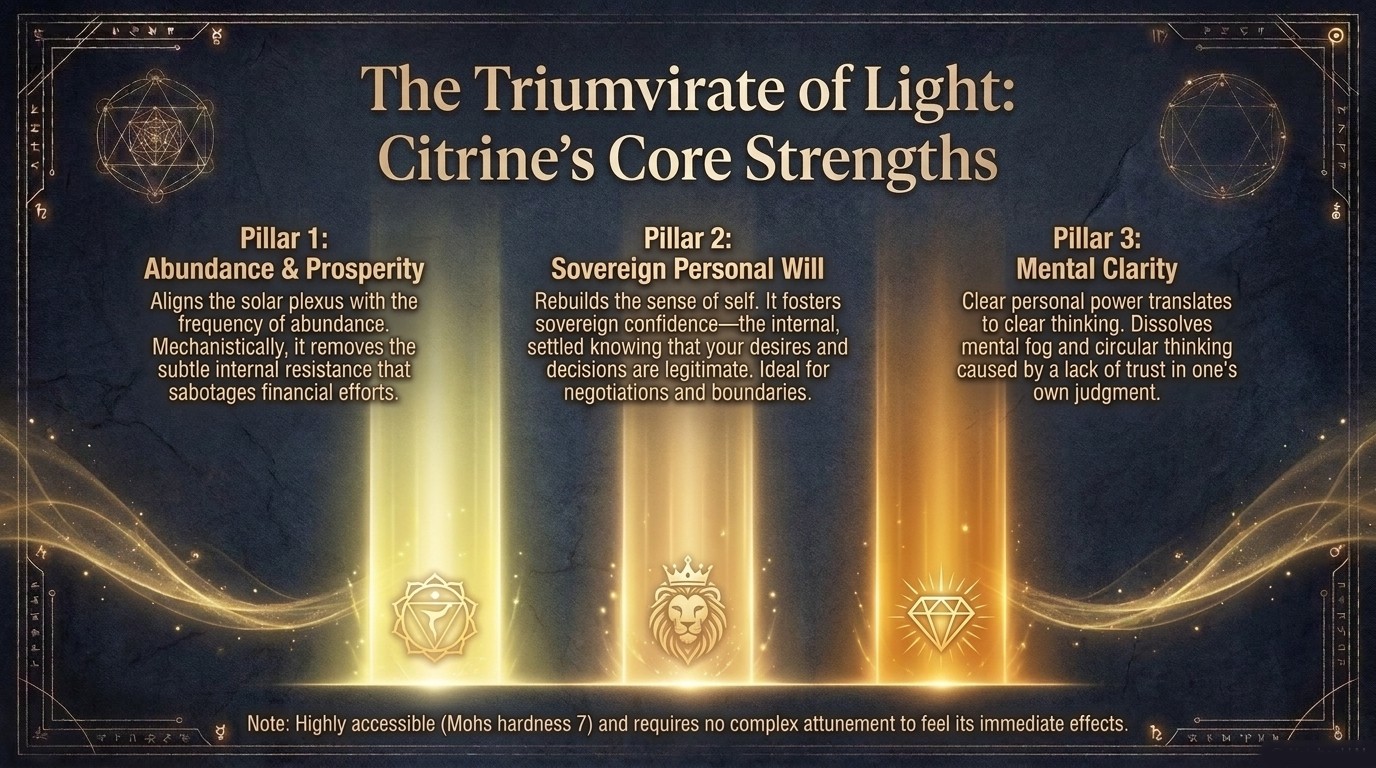
Abundance and Prosperity
This is Citrine’s most documented metaphysical use and the one with the longest historical lineage. Merchants across multiple cultures and centuries kept Citrine in their strongboxes and places of commerce with the belief that it attracted wealth and prevented it from leaving. The specific mechanism, in energetic terms, is that Citrine aligns the bearer’s solar plexus—their sense of personal power and deservingness—with the frequency of abundance, removing the subtle internal resistance that can sabotage financial efforts.
Personal Power and Will
Citrine strengthens the sense of self. It is frequently recommended for people who habitually defer to others, struggle to assert their own needs, or have been conditioned to make themselves small. It builds what might be called sovereign confidence—not the performance of confidence, but the internal settled knowing that one’s desires and decisions are legitimate. This quality makes it useful in professional settings: negotiations, presentations, leadership roles, situations where authority is required.
Mental Clarity and Focus
The solar plexus connection gives Citrine a secondary cognitive quality that is often underemphasized. Clear personal power translates into clear thinking. When you know what you want and believe you are allowed to have it, decision-making becomes significantly less murky. Practitioners use Citrine for mental fog, indecision, and the kind of circular thinking that comes from not trusting one’s own judgment.
Positivity and Mood Elevation
Citrine does not accumulate negative energy—or more precisely, it is said to transmute it rather than absorbing it, which is why it is one of the few stones that many traditions hold does not require regular cleansing. Whether or not one accepts this mechanistic explanation, the phenomenological report is consistent: people working with Citrine tend to feel more optimistic, more engaged with life, and more capable of finding lightness in difficult periods.
Other Notable Associations
- Digestive and metabolic support in traditional healing frameworks—consistent with its solar plexus association.
- Overcoming addiction and self-destructive patterns rooted in low self-worth.
- Protection from spite and jealousy directed at the bearer.
- Creativity and self-expression—dissolving the fear of creative judgment.
Citrine’s Real Strengths
What Citrine does better than almost anything else is make people feel capable.
Not temporarily, not artificially—but in a way that connects them back to genuine capacity they had lost access to. The solar plexus, when working well, is the seat of a person’s relationship with their own life. Citrine’s consistent gift is restoring that relationship when it has frayed.
It is also one of the most accessible stones energetically. Unlike high-vibration stones that require attunement or sensitivity to feel, Citrine’s effects tend to be immediate and legible even to complete beginners. There is very little learning curve, which is partly why it appears in virtually every “starter crystal kit” on the market.
Its durability (Mohs hardness 7) means it handles daily wear without special care. Its relative affordability—at least for natural material in smaller sizes—makes it accessible. And its visual warmth means people actually want to keep it close, which matters more than it might seem: a stone you enjoy looking at is a stone you’ll actually use.
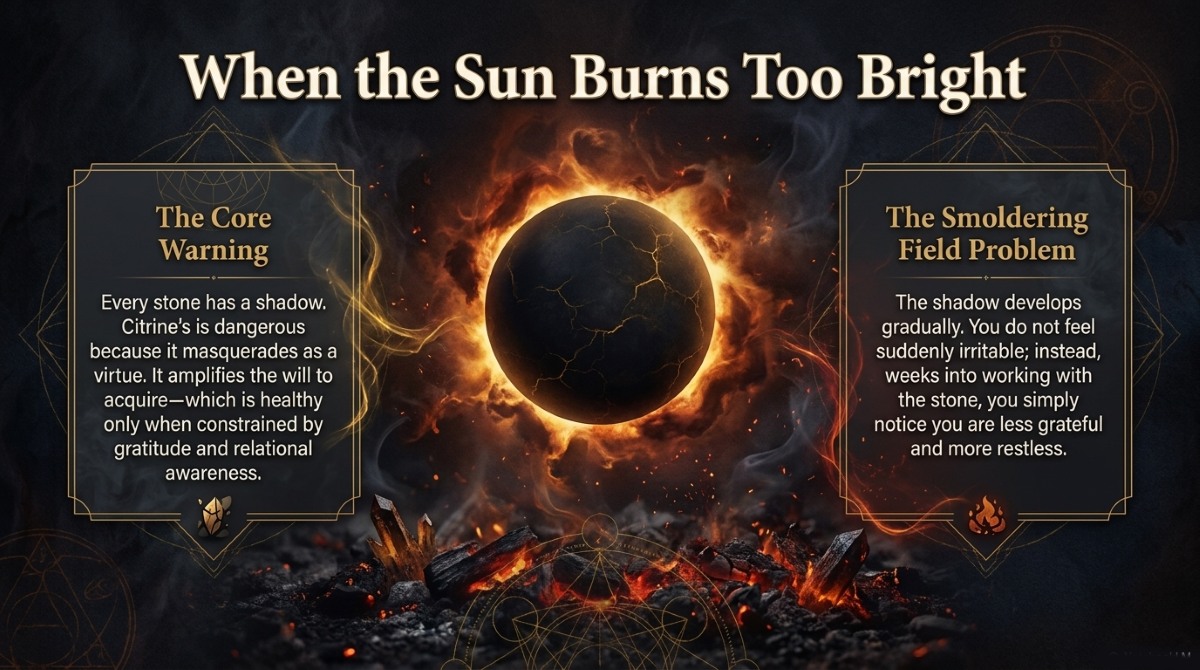
The Shadow Side: When the Sun Burns Too Bright
Every stone has a shadow. Citrine’s is arguably more subtle and therefore more dangerous than most, because it masquerades as a virtue.
Citrine amplifies the desire for abundance, the will to acquire, and the sense that one deserves more. These are healthy energies when they operate within a broader framework of gratitude, contentment, and relational awareness. They become something else when unchecked.
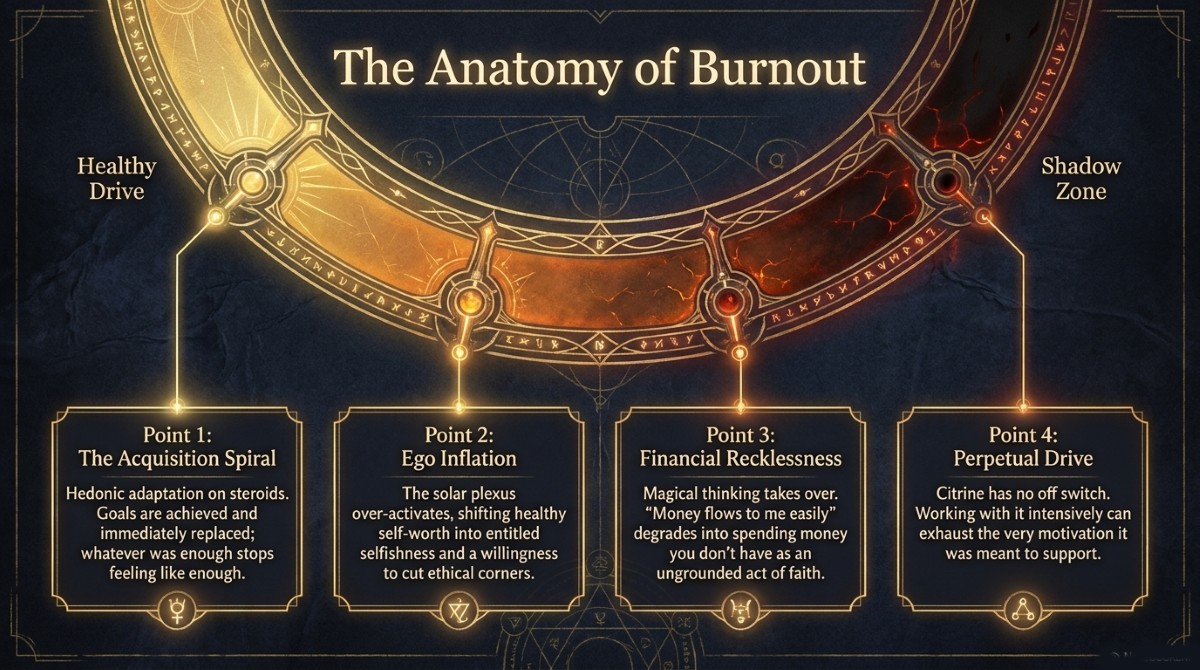
1. The Acquisition Spiral
The most commonly reported shadow experience with prolonged Citrine work is a creeping dissatisfaction with what one already has. The stone is so effective at orienting the mind toward more—more money, more success, more recognition—that it can erode the capacity to appreciate what is already present.
Practitioners describe it as a kind of hedonic adaptation on steroids: whatever was previously enough stops feeling like enough. Goals that once felt ambitious are achieved and immediately replaced by larger ones, with no pause to register the arrival.
2. Ego Inflation and Entitlement
The solar plexus, over-activated without the softening influence of the heart chakra, can shift from healthy self-worth into entitled selfishness. Citrine’s work on personal power is genuinely valuable—until it tips into the belief that one’s needs and desires are simply more important than other people’s. In professional contexts, it can tip healthy ambition into a willingness to cut ethical corners.
3. Financial Recklessness
Citrine’s energy of abundance can, paradoxically, produce poor financial decisions when not grounded. The frequency of “money flows to me easily” becomes counterproductive when it tips into magical thinking—the belief that intention alone is sufficient, that practical caution is a form of limiting belief, that spending money you don’t have is an act of faith in abundance.
4. Burnout from Perpetual Drive
Citrine does not have an off switch. Its solar energy is essentially continuous, which means that extended and intensive work with it can exhaust the very motivation it was deployed to support. The solar plexus, like any energy center, needs rest as well as activation. Citrine can make it difficult to stop, slow down, or receive.
The Smoldering Field Problem
Unlike Carnelian’s acute flare-ups, Citrine’s shadow tends to develop gradually, which makes it harder to identify. You don’t feel suddenly irritable. You simply notice, weeks or months into consistent Citrine work, that you are less grateful, more restless, more focused on what’s missing. By the time the pattern is visible, it is often already embedded.
Who Should Be Especially Careful
Citrine deserves particular caution from:
- People who already have a difficult relationship with money—compulsive spending, financial anxiety, or a tendency to tie self-worth to net worth.
- Anyone in a high-pressure achievement environment where the line between ambition and addiction to success is already blurry.
- People in recovery from workaholism or perfectionism.
- Those who have difficulty resting, receiving, or experiencing satisfaction.
- Anyone already working with other high-drive stones—stacking Citrine with Carnelian, Pyrite, and Tiger’s Eye simultaneously creates an energetic environment that is all accelerator and no brake.
Saffordite: The Grounding Anchor That Keeps Ambition Honest
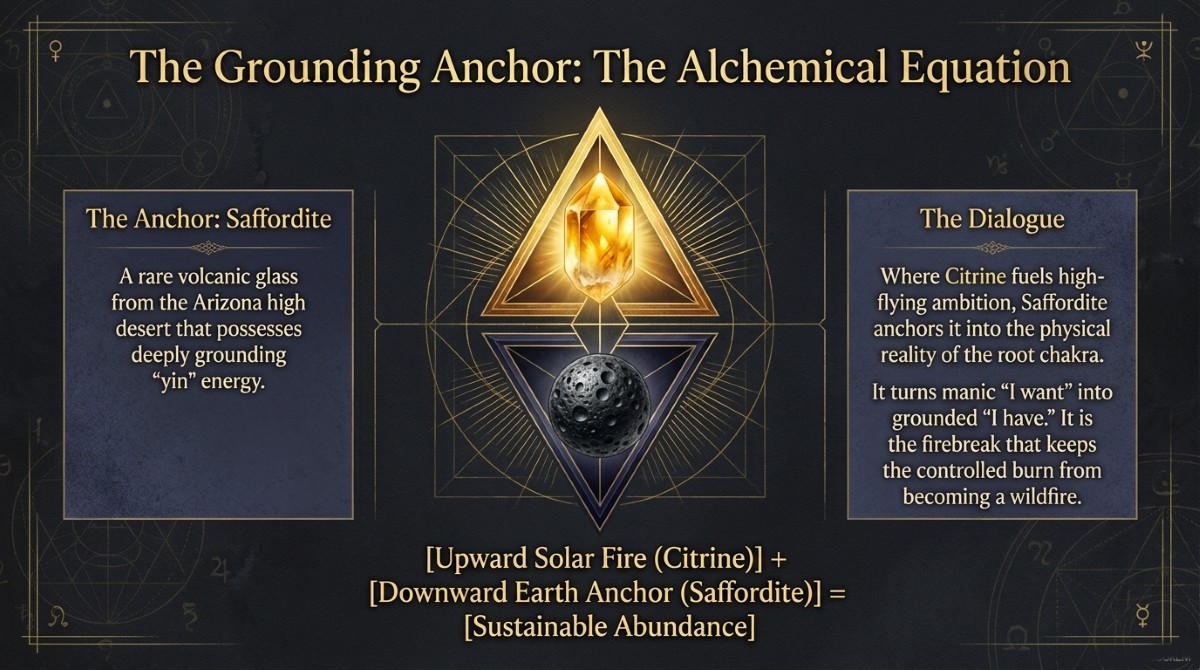
To truly harness the raw power of the Merchant’s Stone without burning out your relationships or your bank account, you need a balancing vessel. Of all the stones that pair well with Citrine in a grounding capacity, one stands apart—and again, it is Saffordite.
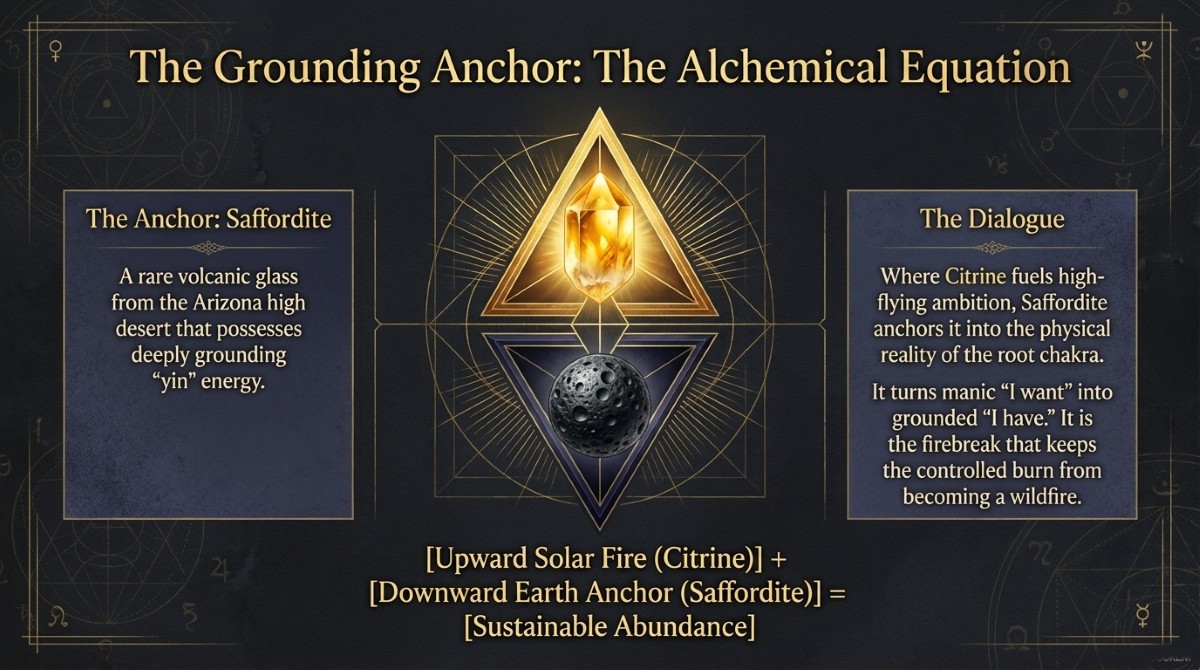
Where Citrine launches energy outward and upward toward acquisition, Saffordite pulls energy inward and downward into the earth. Where Citrine fuels the high-flying, detached ambition of the solar plexus, Saffordite anchors it in the physical reality of the root chakra. It turns the manic “I want” into the grounded “I have.”

Saffordite—the rare volcanic glass collected from the high desert of southeastern Arizona—possesses a deeply grounding “yin” energy that acts as an emotional filter and a structural guide. It provides the exact stabilization that Citrine’s wild, expansive spirit needs to thrive sustainably. This is not a diminishment of Citrine’s gifts. It is the firebreak that keeps the controlled burn from becoming a wildfire.
The two stones work in a perfect dialogue: Citrine speaks loudly in the language of desire, ambition, and visibility. Saffordite listens in the language of silence, gratitude, and still contentment. Together, they create a full-spectrum field that contains the sun without scorching the earth.
The full breakdown of how to work with this pairing — placement, timing, intentions, and the specific qualities Saffordite brings to the relationship — is covered in detail in its own dedicated article:
Citrine and Saffordite: Why the Merchant’s Stone Needs This Clearing Partner to Manifest Cleanly →
How to Use Citrine to Improve Your Life
Ready to integrate Citrine into your routine? Here are the most effective practical methods.
Wear It as Jewelry
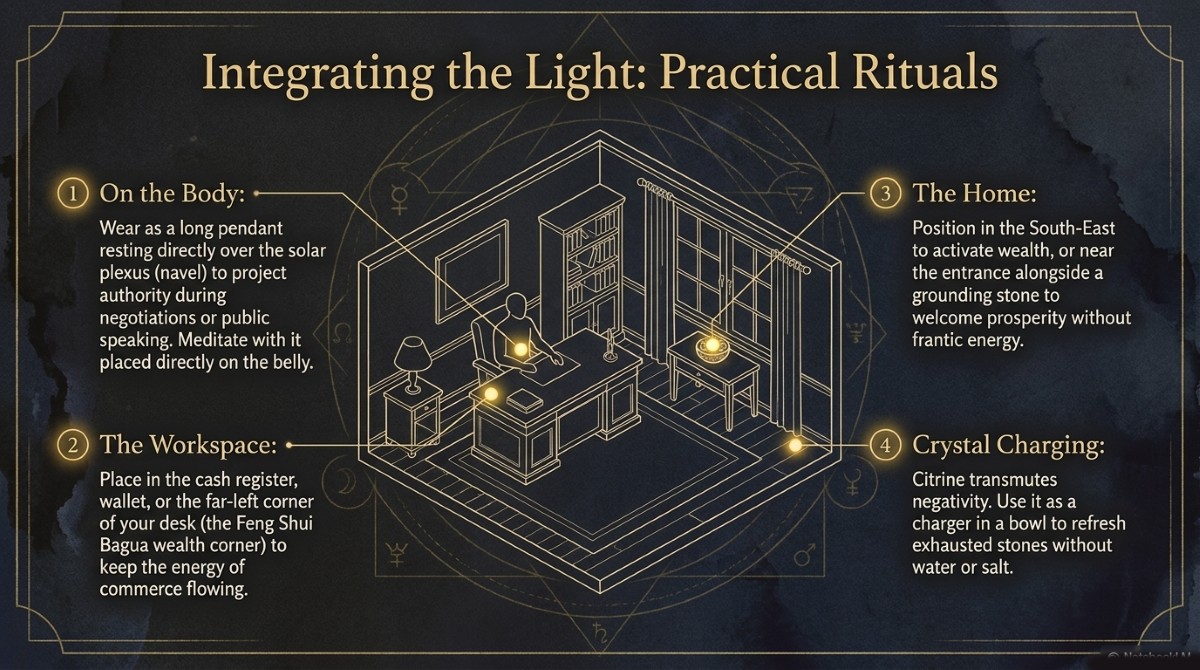
To experience a constant flow of confidence and personal power, wear Citrine as a pendant over your solar plexus, a ring, or a bracelet. A pendant is particularly effective for negotiations, public speaking, or any situation where you need to project authority and clarity.
Meditate for Solar Plexus Balance
If you feel disempowered, anxious, or indecisive, sit quietly during meditation and place a Citrine stone directly onto your solar plexus (just above the navel). Visualize a warm, glowing yellow sphere of light radiating outward from this center, dissolving any knots of fear or self-doubt.
Place It on Your Workspace or Cash Register
This is the classic Merchant’s Stone move. Keep a piece of Citrine in your cash register, wallet, or on your desk (specifically the far-left corner, which is the wealth corner in Feng Shui’s bagua map). It sharpens focus, attracts new business opportunities, and keeps the energy of commerce flowing.
Leverage Feng Shui in Your Home
Place Citrine in the South-East area of your home to activate wealth and abundance, or in the South area to boost fame and reputation. For a more balanced approach, place a Citrine cluster near the entrance to welcome prosperity while pairing it with a grounding stone to prevent the energy from becoming frantic.
Use It as a Crystal Charger
Citrine is one of the few stones that is said to cleanse and charge other crystals simply by sitting next to them in a bowl. Its vibrant solar energy can refresh exhausted stones without the need for water or salt, making it a wonderful addition to any crystal storage box.
Powerful Crystal Pairings
To supercharge your intentions—or, more importantly, to keep Citrine’s intensity balanced—pair it with other high-vibrational stones.
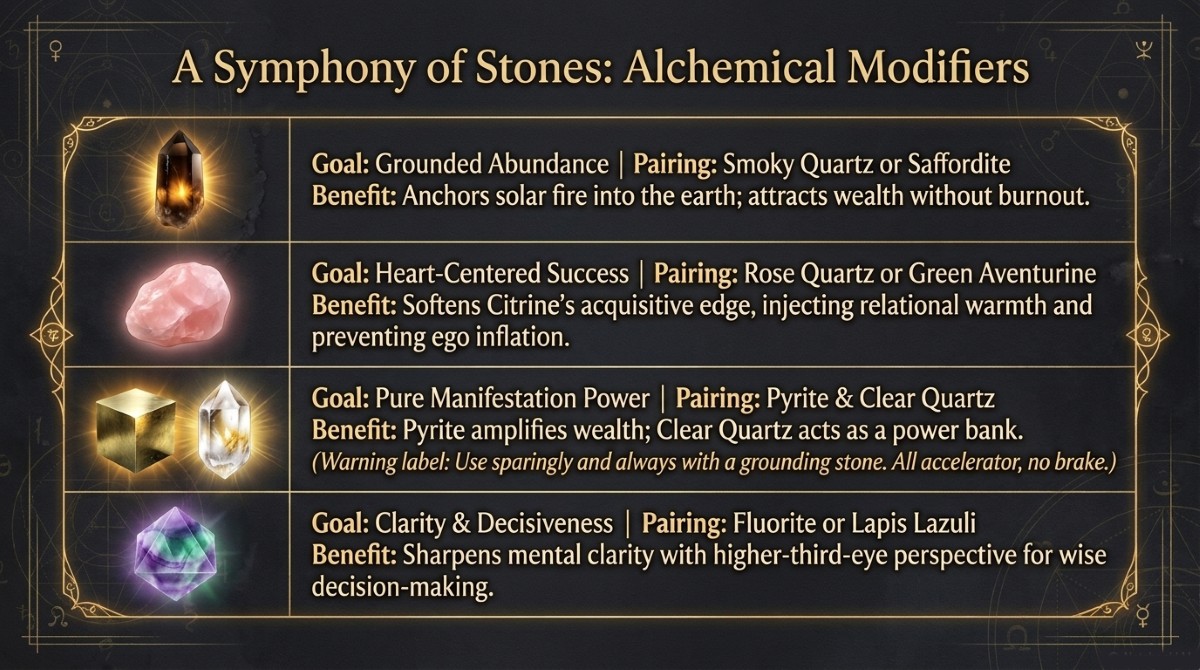
Pairing 1: Citrine + Smoky Quartz or Saffordite (Grounded Abundance)
The idea: Citrine is traditionally an activating, “solar” stone. Practitioners often report that pairing it with a grounding stone keeps ambition from tipping into scattered energy or burnout.
How to actually use it:
The simplest method is the two-pocket carry. Citrine goes in your left pocket, the grounding stone in your right (or reverse it — the tradition varies, and honestly, consistency matters more than sides). The physical act of carrying both becomes a small daily reminder: pursue the goal, stay anchored.
For desk workers, try the workday bookend. Place both stones on your desk. When you sit down, hold the Citrine for thirty seconds and name one concrete thing you want to move forward today. When you finish work, hold the grounding stone and consciously set the workday down. Practitioners describe this as a boundary ritual — a way of telling your nervous system when to push and when to stop.
This is the pairing we reach for most often ourselves, and it’s where Saffordite fits naturally in our own practice. Whether you use Smoky Quartz or Saffordite, the function in the tradition is the same: a counterweight to Citrine’s fire.
Pairing 2: Citrine + Rose Quartz or Green Aventurine (Heart-Centered Success)
The idea: Success-focused stones like Citrine can, in practitioner language, develop an “acquisitive edge.” Heart stones are traditionally paired with them to keep ambition connected to people, not just outcomes.
How to actually use it:
Try the before-the-meeting hold. Before a negotiation, difficult conversation, or pitch, hold both stones for one minute and ask yourself two questions: What do I want from this? (Citrine’s question) and What does the other person need from this? (the heart stone’s question). Nothing mystical is required for this to be useful — it’s a structured empathy check with a tactile anchor.
At home, some practitioners keep this pairing in shared spaces — the kitchen table, the entryway — as a standing reminder that whatever you’re building professionally is ultimately for the people in your life.
Pairing 3: Citrine + Pyrite + Clear Quartz (Pure Manifestation Power)
The idea: In the tradition, this is the all-accelerator combination — Pyrite for wealth focus, Clear Quartz as an amplifier. We put a warning label on this one in the companion guide for a reason: it has no brake built in.
How to actually use it:
Treat this trio like a sprint tool, not a daily driver. Use it for defined pushes — a product launch week, a fundraising deadline, tax season for your business — and then put it away. Practitioners who work with high-activation combinations often describe a “too much coffee” quality when used continuously: restlessness, tunnel vision, difficulty switching off.
A concrete routine: at the start of your sprint, write the specific goal on a slip of paper and place it under the Clear Quartz. Work with the trio on your desk only during the sprint. When the deadline passes — win or lose — remove the paper, and return to a grounded pairing.
And take our warning label seriously: keep a grounding stone in the room. If Citrine alone benefits from an anchor, this combination needs one twice over.
Pairing 4: Citrine + Fluorite or Lapis Lazuli (Clarity & Decisiveness)
The idea: Citrine is traditionally associated with will and confidence; Fluorite and Lapis with mental clarity and perspective. Together, the tradition frames them as a decision-making pair — the confidence to act, tempered by the wisdom to act well.
How to actually use it:
This is the hard-decision pairing. When you’re stuck on a genuine fork in the road — a job offer, a big purchase, a business pivot — try this: hold the clarity stone and write down the decision as neutrally as you can, including what you’re afraid of. Then hold the Citrine and write down what you would do if fear weren’t a factor. Compare the two pages.
The stones don’t make the decision. They give the process structure — two distinct modes of thinking, each with its own physical cue. Many people find that alone worth the practice.
The Honest Bottom Line
None of these routines require you to believe anything in particular about crystal energy. At minimum, they’re intention-setting rituals with physical anchors — and there’s a long human tradition of those working well for focus and follow-through. At maximum, they’re what the metaphysical tradition says they are. Where you land on that spectrum is yours to decide.
What we’d gently push back on is the middle path of owning pairings without using them. A Citrine and Smoky Quartz sitting untouched in a drawer isn’t a practice. Pick one routine above, run it for two weeks, and see what you notice.
And whichever pairing you choose — keep something grounding nearby. That’s not a sales pitch; it’s the one piece of advice that shows up consistently across nearly every practitioner tradition working with activating stones like Citrine.
How to Cleanse and Care for Your Citrine
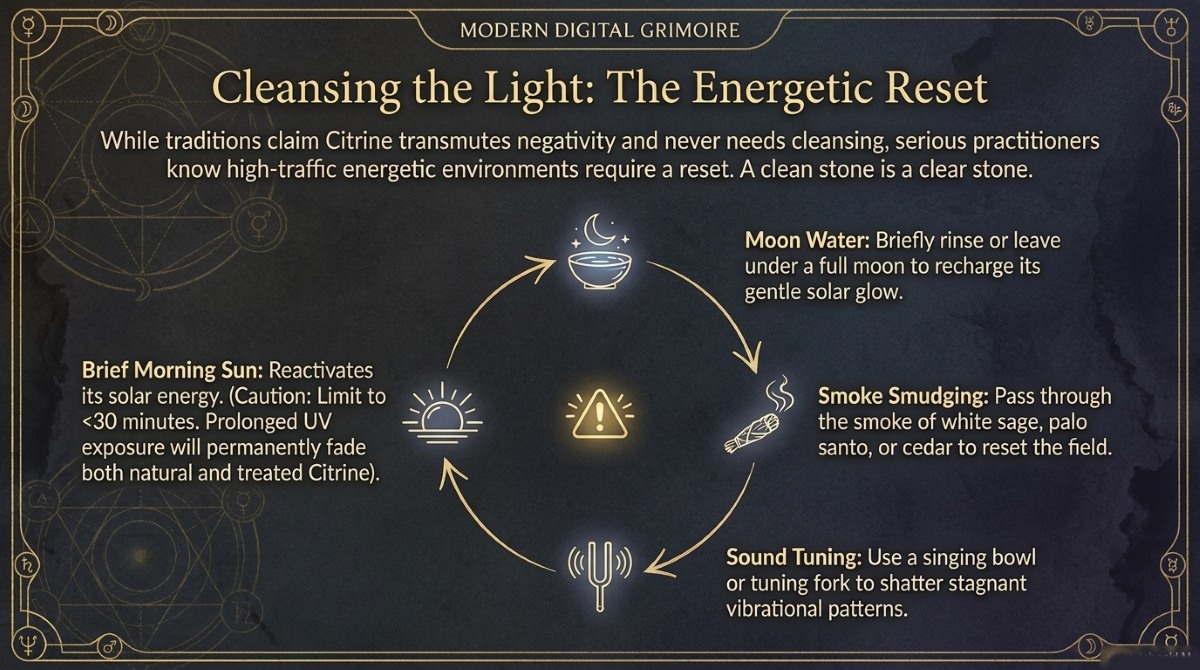
Because Citrine is believed to transmute rather than absorb negative energy, many traditions claim it never needs cleansing. However, most serious practitioners find that any stone working in high-traffic energetic environments benefits from a regular reset. A clean stone is a clear stone.
- Water and Moonlight: Briefly rinse your stone in running water or leave it in a bowl of moon water under a full moon to recharge its gentle solar glow.
- Smudging: Pass your stone through the smoke of white sage, palo santo, or cedar to reset its energetic field.
- Sound Cleansing: Use a singing bowl or tuning fork to break up stagnant vibrational patterns.
- Sunlight (Briefly): A short exposure to the early morning sun can reactivate its energy—but limit this to less than 30 minutes, as prolonged sun exposure can fade the yellow color, especially in heat-treated material.
Final Thoughts
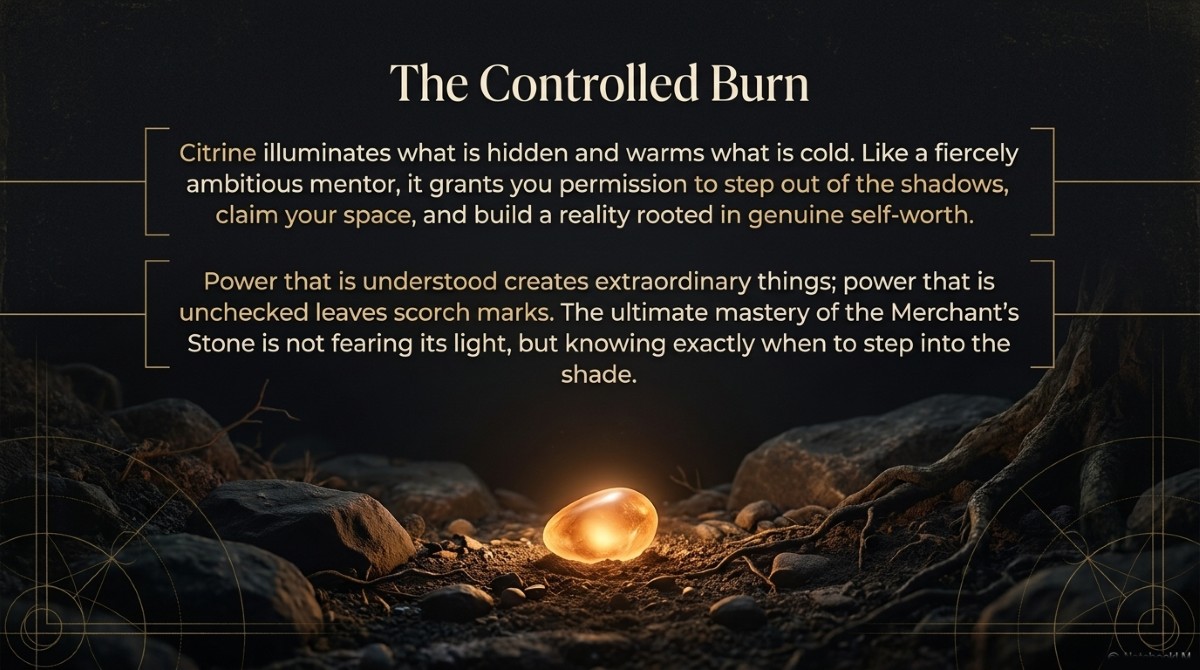
Citrine is like having a confident, ambitious mentor by your side—the kind who believes in you so fiercely that you start believing in yourself. By inviting its warm, autumnal embers into your life, you grant yourself permission to step out of the shadows, claim your space, and build a reality rooted in genuine self-worth.
Citrine has survived thousands of years of continuous human use for the same reason the sun itself has been central to every civilization in history: it is genuinely powerful. It illuminates what is hidden and warms what is cold. But power that is understood and respected creates extraordinary things. Power that is unchecked leaves scorch marks.
The goal is not to fear the light. It is to know when to step into the shade.
Ready to turn Citrine’s relentless drive into sustainable success? Discover how pairing it with Saffordite—rare volcanic glass that anchors solar fire into the earth—creates the balanced abundance engine your wallet and your soul actually need. Check in soon to read our full synergy guide at Saffordites Unearthed.