You’re at a dealer’s table. Two smooth, dark stones sit side by side. Both fit in your palm. One costs five dollars. The other costs five hundred. What makes a stone valuable?
Most buyers can’t explain the difference. They point to beauty, size, or a vague sense of “energy.” But those instincts are easily manipulated. Hype merchants have learned to tell compelling stories — and collectors overpay for common material with a good narrative while genuinely rare stones go unnoticed.
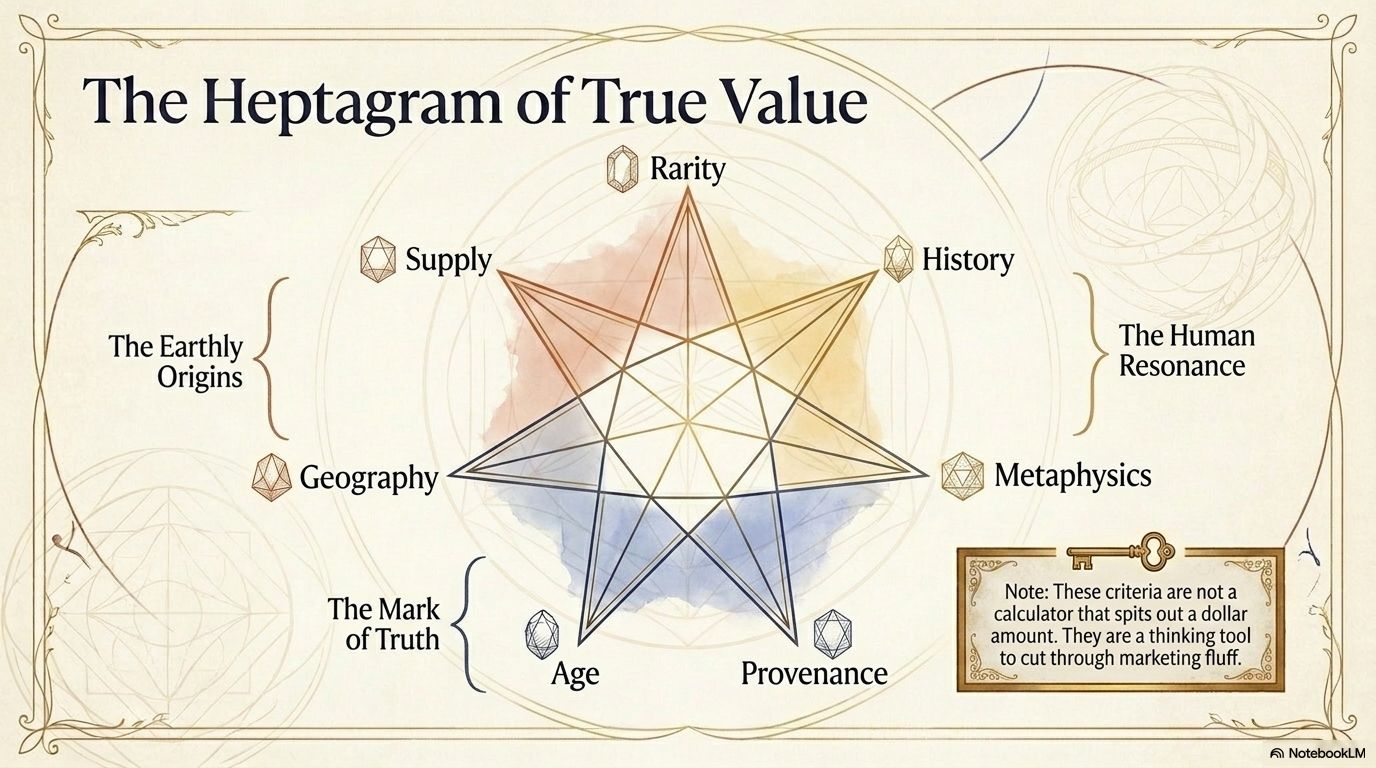
This article offers a different approach to what makes a stone valuable: a set of seven questions that help you think clearly about any stone’s potential lasting value. Value here means the price a knowledgeable collector would likely pay in a stable market — not a rigid prediction, but a structured way to compare stones.
These criteria are not a scorecard that spits out a dollar amount. They are a thinking tool. Use them, and you’ll make sharper evaluations — and spot marketing fluff more easily.
What This Framework Is Not (Important Clarifications)
Before we begin, four caveats:
Rarity ≠ high price. A stone can be geologically rare but have no demand — and thus be nearly worthless. The framework helps you identify potential value drivers, but demand, fashion, and liquidity always matter.
No stone “wins.” Any claim that a particular stone scores perfectly on all criteria is either naive or deceptive. Trade-offs exist.
The framework describes collector markets, not your personal enjoyment. A stone can be beautiful and meaningful to you regardless of its market value. That’s a different question.
Value Drivers vs. Price Drivers. One reason collectors talk past each other is that they often mean different things by “value.”
This framework focuses primarily on structural value drivers — characteristics that tend to persist across decades, such as rarity, finite supply, geographic exclusivity, provenance, and historical significance. These factors help explain why some stones continue to attract collector interest long after fashions change.
Market price, however, is influenced by additional factors that can change rapidly. Beauty, demand, liquidity, condition, size, and fashion cycles often determine what a collector is willing to pay today.
In other words, this framework explains why a stone may deserve attention. It does not guarantee what the market will pay for it at any particular moment.
The distinction matters because many stones become expensive without possessing durable value drivers, while others possess strong value drivers yet remain overlooked for years.
Now, the seven criteria.
What Makes a Stone Valuable: The Seven Criteria
1. Rarity of Formation
Ask: How unusual were the geological conditions that created this stone?
Quartz is abundant — it forms in countless settings on every continent. That’s why even beautiful quartz is affordable. Other materials require freak events: a meteorite impact, an extreme pressure-temperature window, or a vanishingly rare chemical cocktail. The harder nature has to work, the fewer specimens exist — all else being equal, that supports higher value.
But: Rarity of formation is just a starting point. Many rare minerals (e.g., fingerite) are too fragile or obscure to ever command high prices.
Example: Benitoite forms under such unusual conditions that gem-quality crystals come from effectively one location. That rarity contributes to its value — but so does its striking blue color and faceting toughness.
2. Supply Status: Finite vs. Replenishing
Ask: Where is more of this stone coming from?
Most commercial crystals come from active mining operations — Brazilian amethyst, Madagascan rose quartz. Supply adjusts to demand, and prices behave like commodities.
A smaller category comes from closed geological chapters: deposits that formed under conditions that no longer exist and cannot be replenished by any amount of mining investment. When the Benitoite mine ceased commercial operation, the available supply became fixed.
But: A closed deposit doesn’t guarantee high prices. If demand collapses (e.g., due to changing fashion), prices can stay low despite finite supply. Also, “closed” often means “no legal mining” — stockpiles can still emerge from old collections.
Example: Amethyst was once a royal gemstone. Then massive Brazilian deposits were discovered in the 1800s, supply exploded, and prices crashed — not because the stone got less beautiful, but because supply became replenishing rather than finite.
3. Geographic Exclusivity
Ask: How many places on Earth produce this stone?
Quartz comes from everywhere — global materials rarely command premiums. Single-locality stones (tanzanite, larimar, benitoite) carry less risk of a new deposit flooding the market. That geological anchor can support value.
But: Exclusivity cuts both ways. A single locality can be politically unstable, or the mine can be exhausted, killing supply — but also killing the marketing buzz. Some collectors avoid one-locality stones because they’re hard to replace if lost.
Example: Tanzanite is found in one small area near Mount Kilimanjaro. That exclusivity has helped maintain prices — but it also makes the stone vulnerable to supply disruptions and speculation.
4. Age and Measured Time
Ask: How old is it — and can that age actually be pinned to a specific, dated event?
All rocks are old in casual terms. But there’s a difference between a crystal of unknown age and a stone whose formation is radiometrically dated to a precise moment in Earth’s history. Moldavite formed 15 million years ago in a single impact. That timestamp is part of its appeal.
But: Age alone rarely drives price. Most diamonds are billions of years old, but no one pays a premium for “older” diamonds. Age adds value only when it’s measurable, unusual, and connected to a compelling story (cosmic impact, ancient volcanic cataclysm).
Example: Volcanic glasses from radiometrically dated eruptions have a documented birth moment. Collectors value that — but not to the exclusion of beauty or provenance.
5. Verified Provenance
Ask: Can the stone’s origin be scientifically verified — not just claimed?
Walk through any crystal shop and read the labels: “Brazil,” “Madagascar,” “India.” These are not provenances; they are rough geographic regions. Most commercial stones arrive through long, undocumented supply chains.
A smaller number of stones have been studied in peer-reviewed literature, with chemical fingerprints (e.g., X-ray fluorescence, isotope ratios) that can match a specimen to a named source. That verification is valuable because it protects against fakes and misattributions.
But: Verified provenance is rare and often expensive. For most stones under $100, the cost of verification exceeds the stone’s value. Also, provenance is typically batch-level — unless every specimen is individually tested, you rely on dealer integrity.
Example: Moldavite’s market is flooded with counterfeit glass. Authentic, verifiable moldavite (with documented source and testing) commands a significant premium.
6. Human History and Cultural Legacy
Ask: Who valued this stone before you — and can that history be documented?
Some stones carry millennia of continuous human value: turquoise (ancient Egypt, Persia, Indigenous Southwest), jade (Chinese civilization, Mesoamerica), obsidian (prehistoric toolmaking, long-distance trade). That cultural legacy is a real component of value — you cannot replicate it with marketing.
But: “Ancient use” does not automatically make a raw stone valuable. Be careful not to conflate raw material with archaeological artifacts — an unworked nodule from a famous source and a worked ancient tool are entirely different markets, with different prices and different legal rules. (Genuine artifacts are often protected by law and should never be collected or traded casually.)
Example: Obsidian from specific sources (e.g., Glass Buttes, Obsidian Cliff) can be chemically traced to prehistoric trade routes. That provenance adds interest — but the raw material still sells for modest prices unless shaped or mounted.
7. Metaphysical Demand
Ask: Does the metaphysical community seek this stone — and is that demand likely to last?
Whatever your personal beliefs, metaphysical demand is a real market force. Moldavite’s price surge over the past decade was driven largely by spiritual seekers. This criterion is honest about that reality.
But: A metaphysical demand built solely on hype is fragile — it spikes with social media trends and can collapse just as fast. Demand that aligns with a stone’s physical story (age, volcanic origin, exclusivity) tends to be more durable because the narrative holds up to scrutiny.
Example: Clear quartz has enduring metaphysical demand (“amplifier,” “master healer”) but almost no scarcity — so prices stay low. Moldavite’s metaphysical reputation rests on a genuinely rare, dated impact glass, which supports higher and more stable pricing.
Three Market Modifiers the Framework Does Not Measure
The seven criteria identify structural sources of value. They do not directly measure three factors that often dominate short-term pricing.
Beauty
Beauty is one of the strongest drivers of market price. Color, translucency, pattern, luster, symmetry, and visual impact all affect what collectors are willing to pay.
A visually stunning stone can command a premium even if it scores modestly on several of the seven criteria. Likewise, a geologically fascinating stone may remain inexpensive if few people find it attractive.
Demand and Collector Recognition
A stone can be rare and still have little market value if few people know about it or actively seek it out.
Demand can arise from jewelry use, collector communities, scientific interest, cultural significance, or metaphysical popularity. Collector recognition often develops slowly. Many now-famous stones spent decades in relative obscurity before broader markets discovered them.
Liquidity
Liquidity asks a simple question: If you needed to sell this stone tomorrow, how easily could you find a buyer?
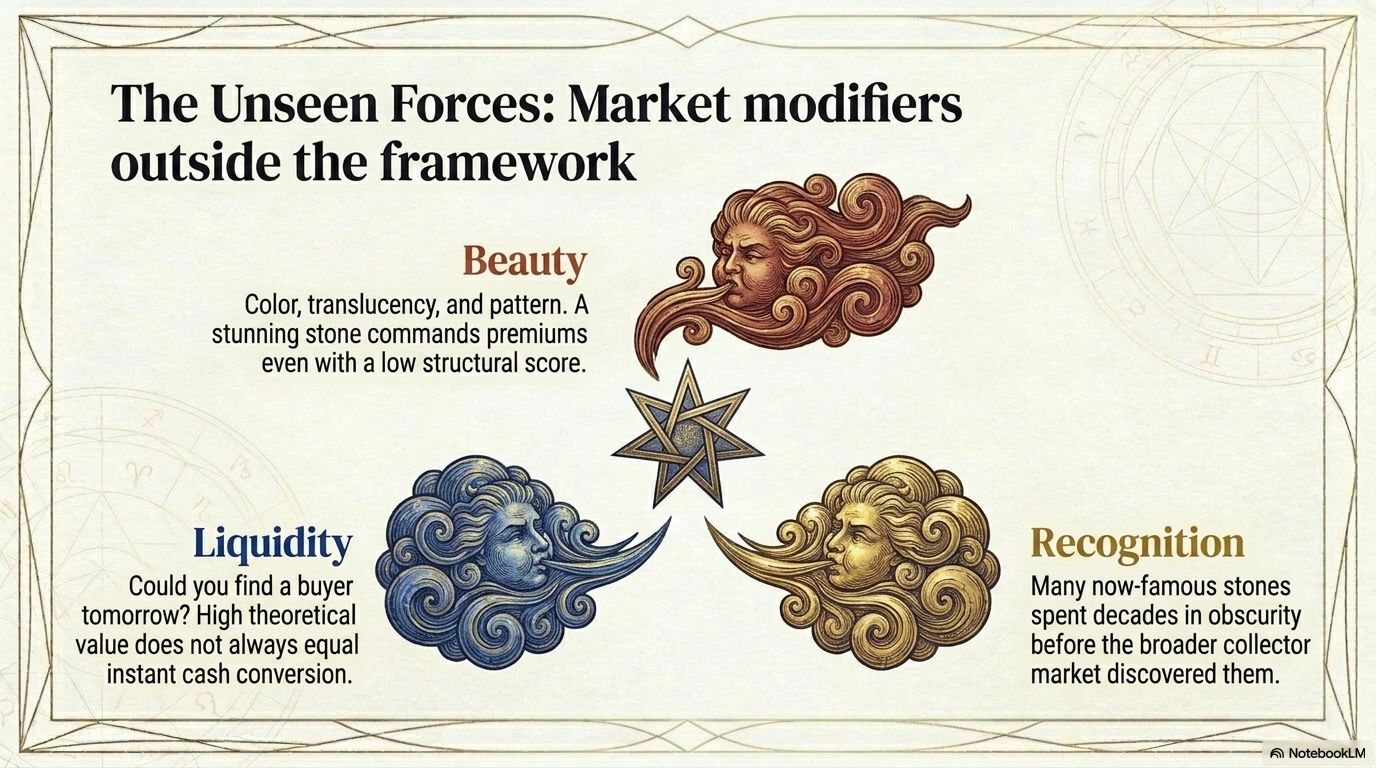
Some stones have active international markets with thousands of potential buyers. Others appeal to only a handful of specialists. A stone can possess substantial theoretical value yet remain difficult to convert into cash.
Value and liquidity are related but not identical concepts.
How to Use the Seven Criteria
When you pick up a stone — at a gem show, in a shop, online — run it through these questions. But don’t simply “count criteria” and assume a higher score means a higher price. Instead, think about:
Which criteria are genuinely satisfied? Be skeptical of dealer claims, especially for provenance and age.
What’s missing? The framework does not account for beauty, durability, cut quality, size, or current market trends — all of which affect price.
Trade-offs exist. A stone with great geographic exclusivity but no demand is worth little. A stone with strong metaphysical demand but a replenishing supply may have volatile prices.
Example Scoring (For Illustration, Not Prescription)
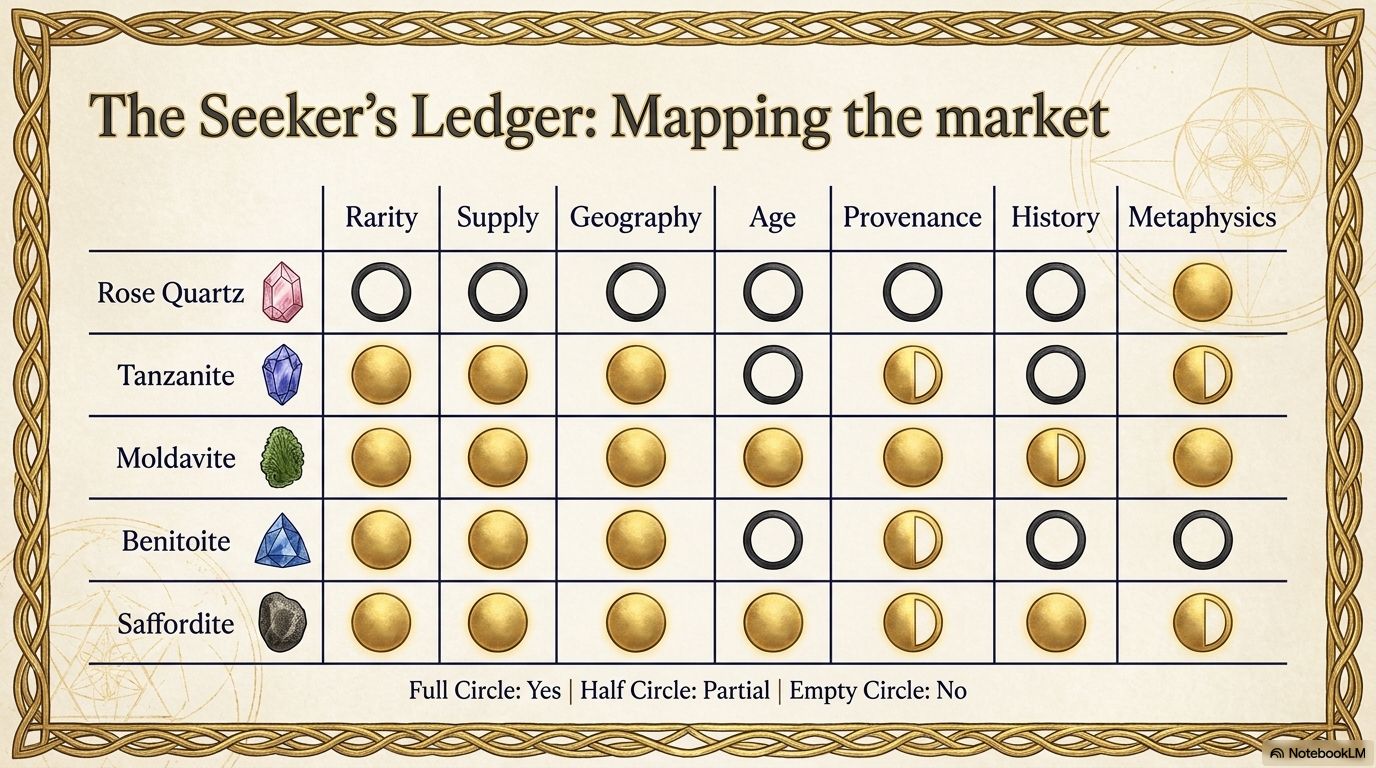
*Source glass has documented use from Clovis times onward — but remember criterion 6: raw nodules are not artifacts.
No stone scores “perfectly” — and that’s fine. The goal is not a winner but a clearer understanding of what you’re paying for.
What This Framework Does Not Tell You
The seven criteria identify structural value drivers, but several important considerations remain outside the framework.
Condition
Two otherwise identical stones may have dramatically different values depending on chips, fractures, repairs, weathering, or damage. Condition matters in nearly every collector market.
Size
Larger specimens are generally more valuable when quality remains constant. Size alone does not create value, but it can amplify other value drivers.
Liquidity
Can you sell the stone quickly for cash? Some collector stones have active secondary markets; others may require months or years to find the right buyer.
Transaction Costs
Dealer markups, certification fees, shipping, insurance, and auction commissions all affect realized value.
Fashion Cycles
Collector preferences change. Materials that were once highly prized can become commonplace, while overlooked stones sometimes experience sudden popularity.
Beauty
Color, pattern, luster, translucency, and overall visual appeal influence price enormously. The framework intentionally focuses on structural characteristics rather than aesthetics, but no serious collector should ignore beauty.
Your Own Enjoyment
A stone’s market value and its personal value to you are separate questions. A common stone that inspires curiosity, wonder, or meaning may be more rewarding than a rare stone purchased solely as a speculative asset.
Where Saffordite Fits (Disclosure: We Sell It)
This site exists because of one stone — Saffordite, a translucent volcanic glass found in a single Arizona valley — and we sell it. So read what follows with the same skepticism this article just taught you.
Run through the framework, our honest count is this:
- Saffordite scores strongly on rarity of formation, finite supply, geographic exclusivity, and measured age (one of its two volcanic sources is radiometrically dated to 17.7 million years).
- It scores partially on provenance — the source eruptions are documented in peer-reviewed studies, but a dedicated published study of the collector stone itself does not yet exist.
- Its documented human history is real but belongs to usage of the source glass (e.g. Obsidian tools), not to individual nodules.
- And its metaphysical following, while growing, is a fraction of moldavite’s — which also means low liquidity.
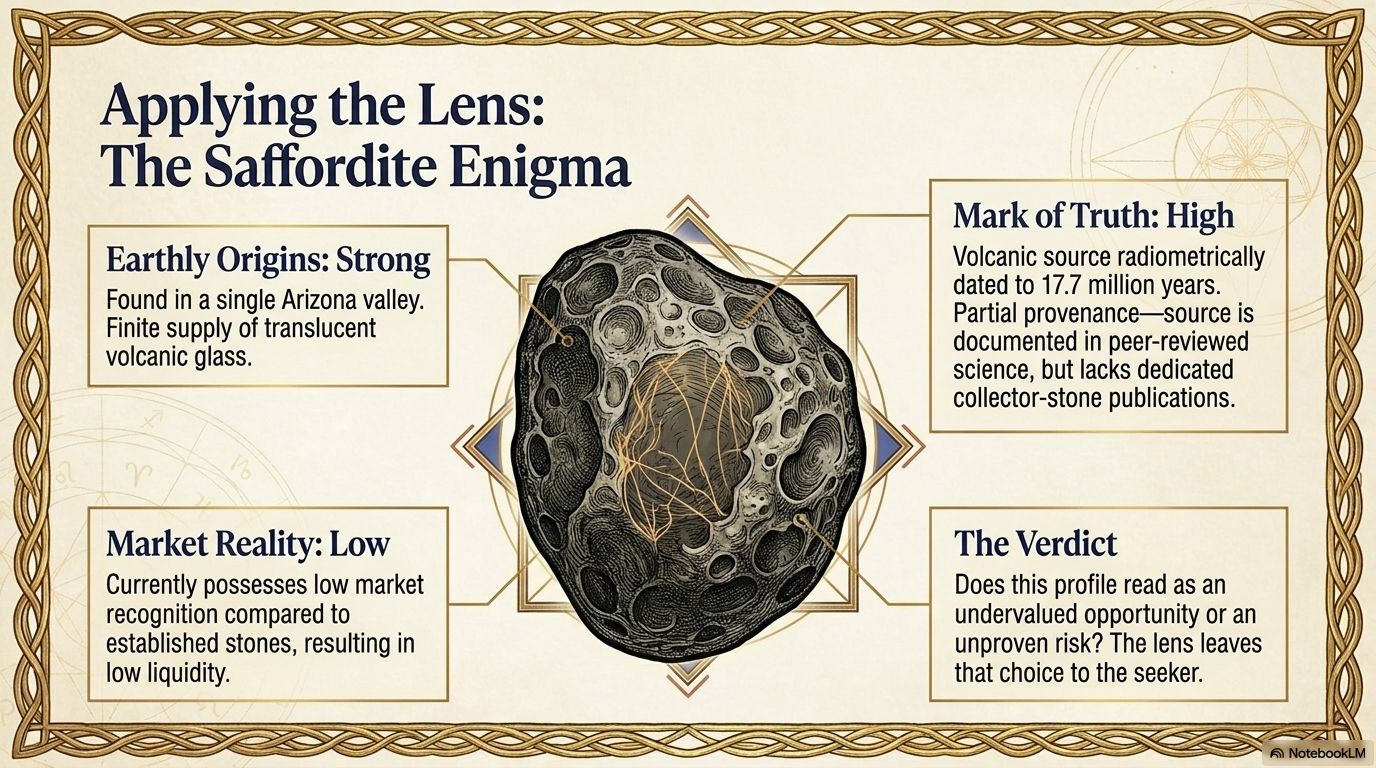
Whether that profile reads as “undervalued” or “unproven” depends on you.
We make the full case, evidence and gaps included, in Why Saffordite Is One of the World’s Most Valuable Stones.
The peer-reviewed science behind its volcanic origins is traced in The Arizona Mystery: The Origins of Saffordite,
If you’d rather evaluate the stone in the field than in a shop, start with Where to Find Saffordite in Arizona.
Final Thoughts
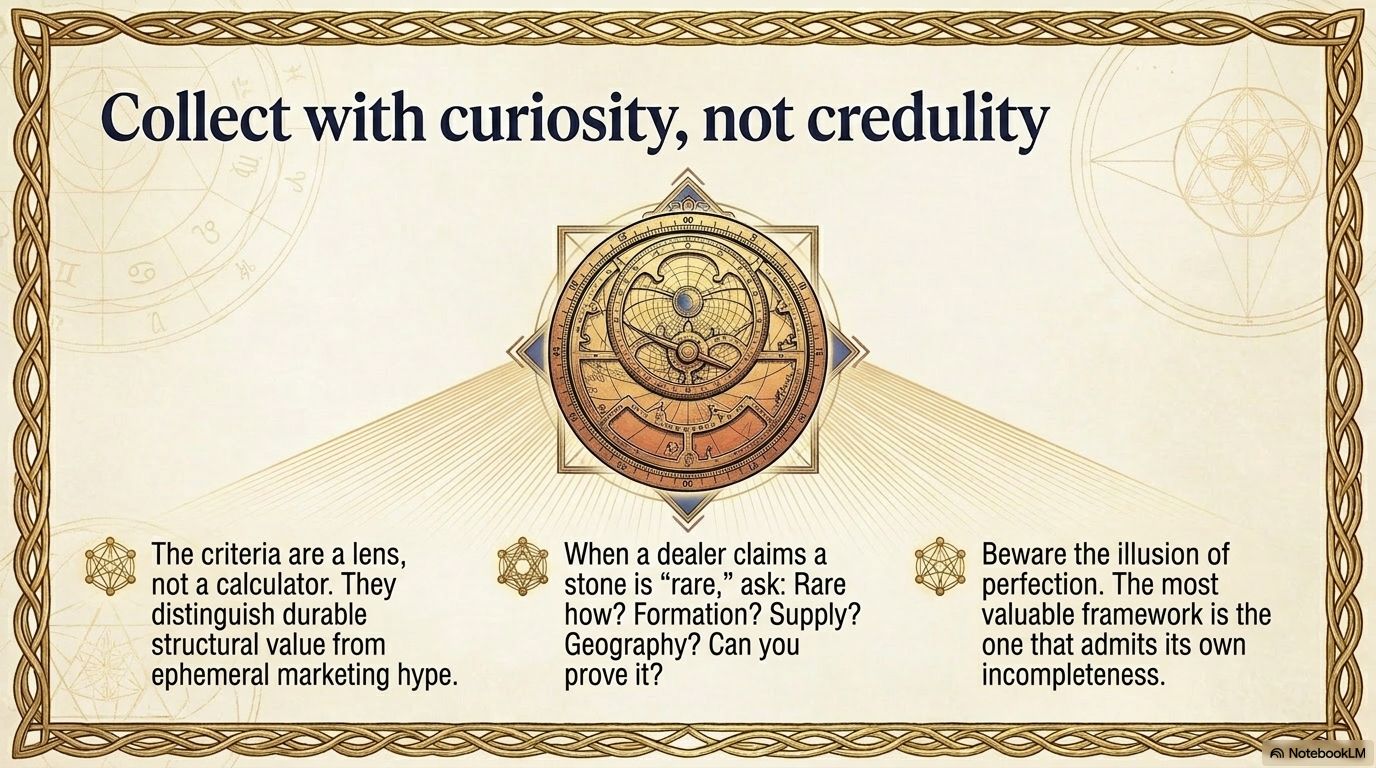
The seven criteria are a lens, not a calculator. They help you distinguish between durable value drivers (finite supply, verified provenance) and ephemeral ones (hype, vague storytelling). They also expose the limits of your own knowledge — which is their real gift.
Next time a dealer tells you a stone is “rare,” you’ll know to ask: Rare how? Formation? Supply? Geography? Can you prove it?
And if someone claims a particular stone scores perfectly on all seven criteria, you’ll recognize that as marketing — because the most valuable framework is one that admits its own incompleteness.
Collect with curiosity, not credulity.