If you have ever held a piece of Saffordite — that dimpled, black stone found in the creek beds and river gravels near Safford, Arizona – you have probably wondered where it actually comes from. Collectors call it Saffordite, Cintamani, or Desert Glass. Some say it fell from space. Others say it formed in ancient lightning strikes. The metaphysical community prizes it for its grounding properties, rarity, and beauty.
But here is something most collectors do not know. A scientist spent decades methodically mapping every source of volcanic glass across Arizona, New Mexico, and northern Mexico. He analyzed hundreds of artifacts from prehistoric sites. He walked the creek beds and river gravels of eastern Arizona, identifying exactly which glass came from where. And the research trail he left behind — four separate studies conducted over nearly thirty years — points with remarkable clarity toward a specific answer to the Saffordite question. That answer has been sitting in the scientific literature, largely unnoticed by the collecting community, for over a decade.

The Scientist Who Mapped Arizona’s Volcanic Glass
Starting in the mid-1980s, an anthropologist named M. Steven Shackley set out to solve a practical problem. Prehistoric peoples across the American Southwest used volcanic glass to make their tools. When archaeologists dug up those tools at ancient sites, they had no reliable way to figure out where the glass originally came from. Shackley wanted to build a reference library that would answer that question.

His method was elegant. Every volcanic source produces glass with a unique chemical signature — specific amounts of elements like rubidium, strontium, and zirconium that are locked into the glass at the moment of eruption and never change. Using a technique called X-ray fluorescence, or XRF, Shackley could read those chemical signatures from a piece of glass without even damaging it. It works essentially like a fingerprint database — collect the fingerprints of every known source, then compare unknown samples against them.
Over nearly thirty years, Shackley published four studies that together build a compelling and specific case about the volcanic glass found in the Safford Valley.
Four Studies, One Increasingly Clear Answer
The 1988 study established the first comprehensive chemical reference library for volcanic glass across Arizona, New Mexico, and northern Sonora. Among the sources Shackley documented was the Cow Canyon source in Greenlee County, northeast of Safford, whose glass erodes into the Gila River drainage system flowing directly through the Safford Valley. Source: SOURCES OF ARCHAEOLOGICAL OBSIDIAN IN THE SOUTHWEST: AN ARCHAEOLOGICAL, PETROLOGICAL, AND GEOCHEMICAL STUDY.
The 1995 study upgraded that data to internationally standardized measurements and confirmed that both Cow Canyon glass and glass from the Mule Creek volcanic complex in western New Mexico were present and mixed together in the Gila River alluvium near Safford. Source: SOURCES OF ARCHAEOLOGICAL OBSIDIAN IN THE GREATER AMERICAN SOUTHWEST: AN UPDATE AND QUANTITATIVE ANALYSIS
The 2006 study analyzed 96 obsidian artifacts chemically from archaeological sites in Graham County — the county containing Safford — and found that approximately 80 percent were Cow Canyon glass. Shackley explicitly stated that prehistoric peoples in the area were collecting raw glass nodules directly from the Gila River gravels in the Safford and San Carlos Valleys. Source: SOURCE PROVENANCE OF OBSIDIAN ARTIFACTS FROM THE DOS POBRES/SAN JUAN PROJECT, GRAHAM COUNTY, ARIZONA
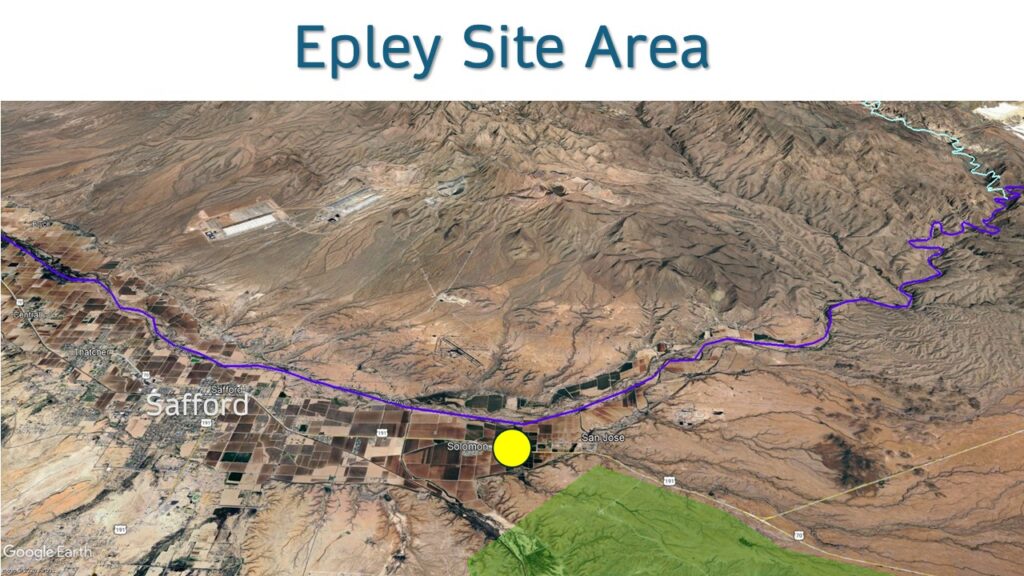
The 2013 study is the most significant of all for the Saffordite question. It analyzed 24 obsidian artifacts from the Epley Site — an archaeological site located in Solomon (just east of Safford), directly in the Safford Valley — and produced findings that fundamentally sharpen our understanding of what glass is actually present in the valley and where it comes from. Source: SOURCE PROVENANCE OF OBSIDIAN ARTIFACTS FROM THE EPLEY SITE (AZ CC:2:64 ASM), GRAHAM COUNTY, ARIZONA

The 2013 Epley Site Study: Ground Zero for Saffordite
The Epley Site study matters above all the others for one simple reason: it is physically located in the Safford Valley itself. Not nearby. Not upstream. In the valley where Saffordite is collected. The artifacts analyzed are prehistoric tools made from glass nodules that were picked up from the local landscape — the same landscape where collectors find Saffordite today.
The chemical analysis produced several findings that directly address the Saffordite question.
Mule Creek glass dominates — a surprising result. Unlike the 2006 study, where Cow Canyon glass made up roughly 80 percent of the assemblage, the Epley Site showed the opposite pattern. Of 24 artifacts, 15 — fully 62.5 percent — were made from Mule Creek glass, specifically the Antelope Creek subgroup. Cow Canyon glass accounted for only about 29 percent. This is a striking reversal that tells us something important: within the Safford Valley itself, the ancient lake bed and river sediments contain substantial quantities of Mule Creek glass, not just Cow Canyon glass. Both are present. Both were being used. And both are almost certainly present in the nodules collectors pick up today.
The 111 Ranch Formation is named as the direct source. Shackley specifically identifies the 111 Ranch Formation — an ancient lake bed deposit sitting in the Safford Valley — as the likely source of the glass nodules used to make the Epley Site tools. He describes nodules in this formation as up to 50 millimeters — about two inches — in diameter. These nodules are water-worn, crystal-free, and variable in color. They are sitting in an ancient geological deposit within the Safford Valley itself, gradually being re-exposed by ongoing erosion. When a collector walks a dry creek bed near Safford and picks up a black translucent stone, there is a very good chance they are picking up a nodule that eroded out of the 111 Ranch Formation.
Cow Canyon has been eroding into the Gila River for at least 10 million years. The 2013 paper contains the clearest age statement across all four studies. Shackley states directly that the Cow Canyon source has been eroding into the Gila River for at least 10 million years. This is the first time a specific age is given, and it places the Cow Canyon eruption firmly in the late Miocene epoch — a time when much of Arizona looked dramatically different from today.
A persistent mystery source keeps appearing. One artifact at the Epley Site — sample PD 1302 — did not match any known source cleanly. Its chemistry resembles Cow Canyon but with elevated readings for two key elements. Shackley notes this same chemical signature has appeared at other eastern and southern Arizona sites and suggests it could be either an undiscovered source somewhere in southern Arizona or northern Mexico, or a distinct chemical variant from the same ancient magma system that produced Cow Canyon. Crucially, this is the second time across the four Safford Valley studies that this anomalous signature has appeared. It showed up in the 2006 study, too. Its persistence across two separate studies seven years apart suggests it is real — and raises the possibility that a small proportion of what collectors call Saffordite may come from a volcanic source that has not yet been formally identified.
What Is Actually in Those River Gravels Near Safford?
Putting all four studies together, the picture of the Safford Valley’s glass landscape becomes remarkably specific.
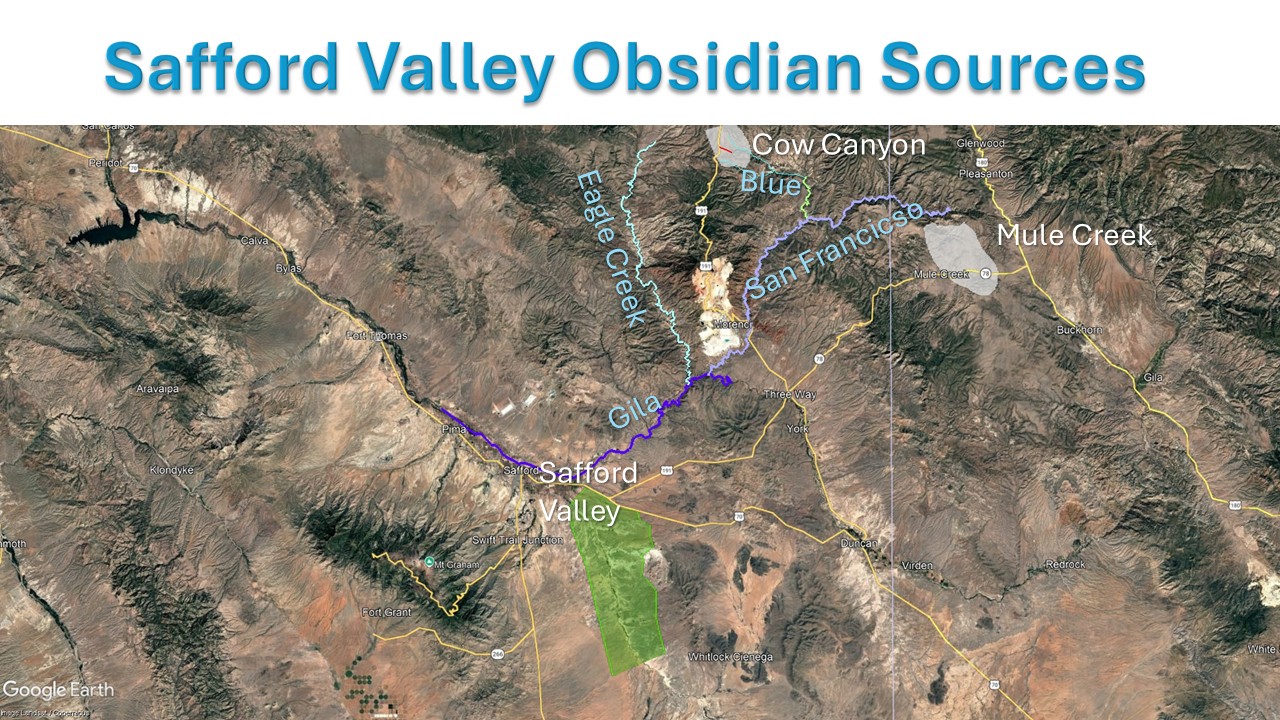
The valley sits at the downstream end of two ancient river systems that drain two major volcanic glass sources. The first is the Cow Canyon source in Greenlee County to the northeast — a Neogene volcanic deposit approximately 10 million years old that has been steadily shedding glass nodules into Eagle Creek, the Blue River, and ultimately the Gila River for that entire time. The second is the Mule Creek volcanic complex in western New Mexico to the east — a cluster of related volcanic deposits precisely dated at 17.7 million years old that has been contributing glass to the Gila drainage for even longer.
Over millions of years, nodules from both sources have accumulated in the ancient lake bed sediments of the 111 Ranch Formation in the Safford Valley and in the active Gila River alluvium. The nodules are rounded from long tumbling in water. They are crystal-free and translucent in the way characteristic of older Tertiary volcanic glass. They range in color from near-transparent light-amber to amber to smoky gray, with some banding. They are typically under 2 inches in diameter.
This description matches Saffordite precisely.
Based on the Epley Site findings — which represent the most geographically specific study of all — the glass in the Safford Valley appears to be roughly 60 to 65 percent Mule Creek and 25 to 30 percent Cow Canyon, with a small additional percentage of uncertain origin. The 2006 study from slightly different sites in Graham County showed a higher Cow Canyon proportion, suggesting the exact ratio varies by location within the valley.
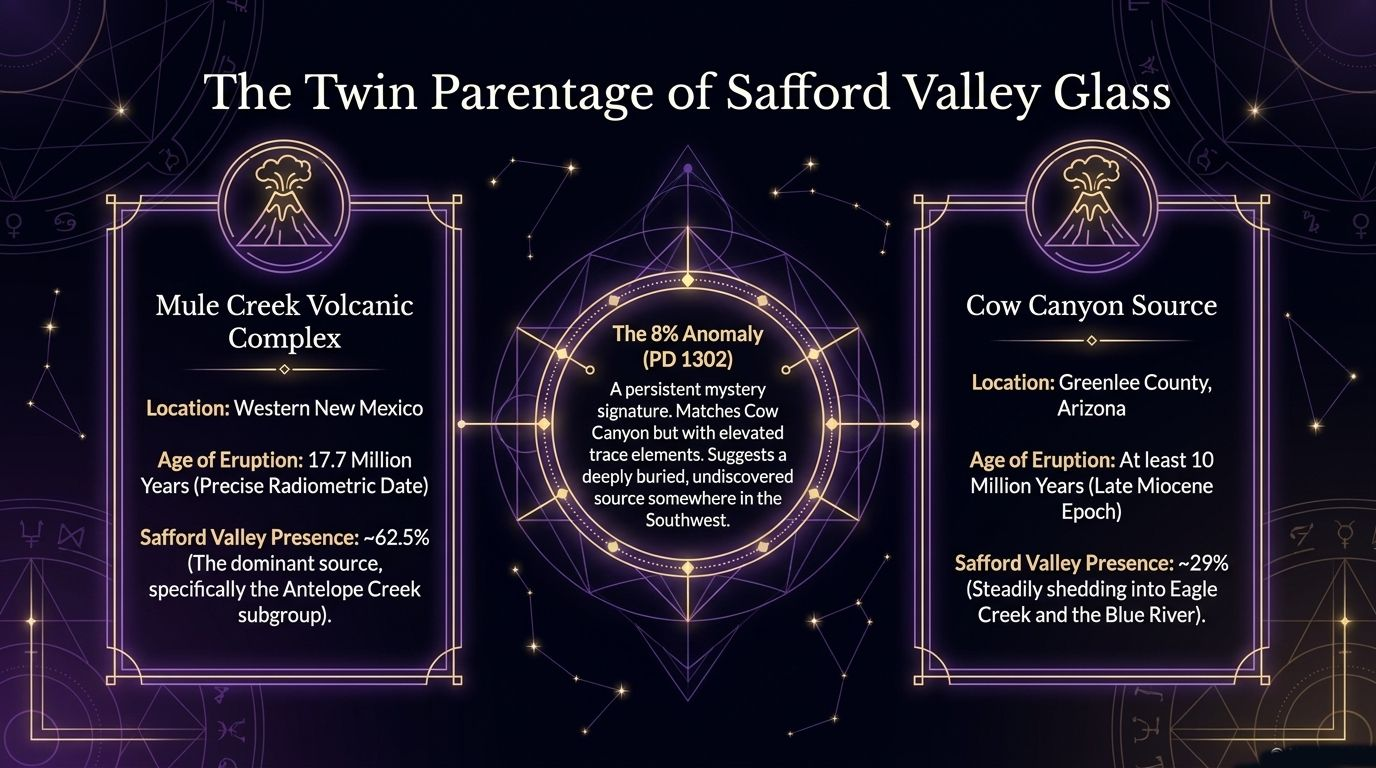
The practical implication is that a collection of Saffordite specimens gathered from across the Safford Valley likely contains a mixture of both sources — visually indistinguishable from each other, but chemically distinct, and originating from eruptions 10 and 17.7 million years ago, respectively.
Why Does Saffordite Look So Different From Regular Obsidian?
This question comes up often, and science provides a clear answer.
Most of the black obsidian that people are familiar with comes from relatively young volcanic eruptions — in northern Arizona, for example, where eruptions occurred tens of thousands of years ago, and the glass is still in large angular chunks close to where it formed. That glass tends to be opaque black because of microscopic iron oxide particles in the lava, and it is often coarse enough that tiny crystals are visible under magnification.
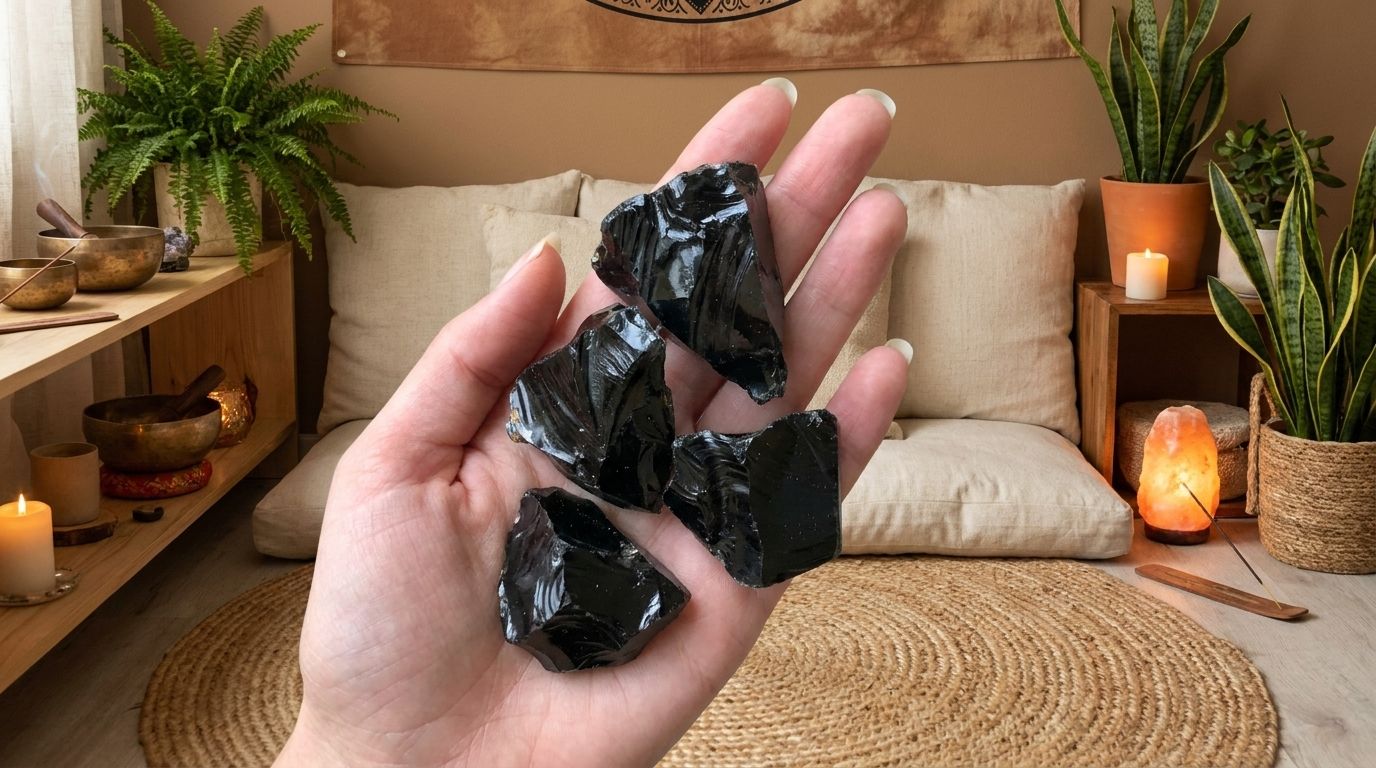
The glass near Safford is completely different in origin. It comes from volcanic eruptions that occurred 10 to 18 million years ago — an almost incomprehensibly long time ago. These older sources tend to produce glass with a chemistry that results in much greater translucency and color variation. The glass is also crystal-free in a way that younger volcanic glass often is not.
On top of that, the nodules have been tumbling through river and lake systems for millions of years. That extraordinary journey smooths and rounds them, removes any rough outer crust, and produces the characteristic water-polished surface that makes Saffordite so tactilely appealing. The result is a stone that looks and feels entirely unlike the sharp black chunks of obsidian most people picture — which explains why so much mystery has surrounded its origins.
How Old Is Saffordite?
This question has two answers depending on what you mean.
The age of the eruption that produced the glass is approximately 10 million years for the Cow Canyon component and 17.7 million years for the Mule Creek component. These are not estimates. The Mule Creek age is a precise radiometric date. The Cow Canyon age is stated directly by Shackley in the 2013 paper as a minimum — the actual eruption may be somewhat older.
The age of the nodule you are holding is different. The 111 Ranch Formation sediments in the Safford Valley were deposited during the Pliocene and Pleistocene — roughly 2 to 5 million years ago — meaning glass nodules have been sitting in those specific deposits for at least that long. Some nodules may be more recently eroded from upstream sources. Others may have been sitting in valley sediments for millions of years before a collector picked them up.
In plain terms: the stone in your hand was created by a volcanic eruption somewhere between 10 and 18 million years ago, has been traveling through river and lake systems for millions of years, has been sitting in the Safford Valley in recognizable form for at least 2 to 5 million years, and was being collected and used by the earliest humans in North America at least 13,000 years ago.
People Have Been Picking Up These Stones for 13,000 Years
What 13,000 Years Ago Actually Looked Like
At the end of the last ice age — roughly 13,000 years ago, when Clovis people were using this glass — the American Southwest was a significantly wetter and more dynamic landscape than it is today. The Gila River and its tributaries were running higher and faster, fed by melting glaciers and higher precipitation across the region. The San Francisco River and Eagle Creek systems draining the Cow Canyon source area would have been actively transporting glass nodules downstream with considerable energy.
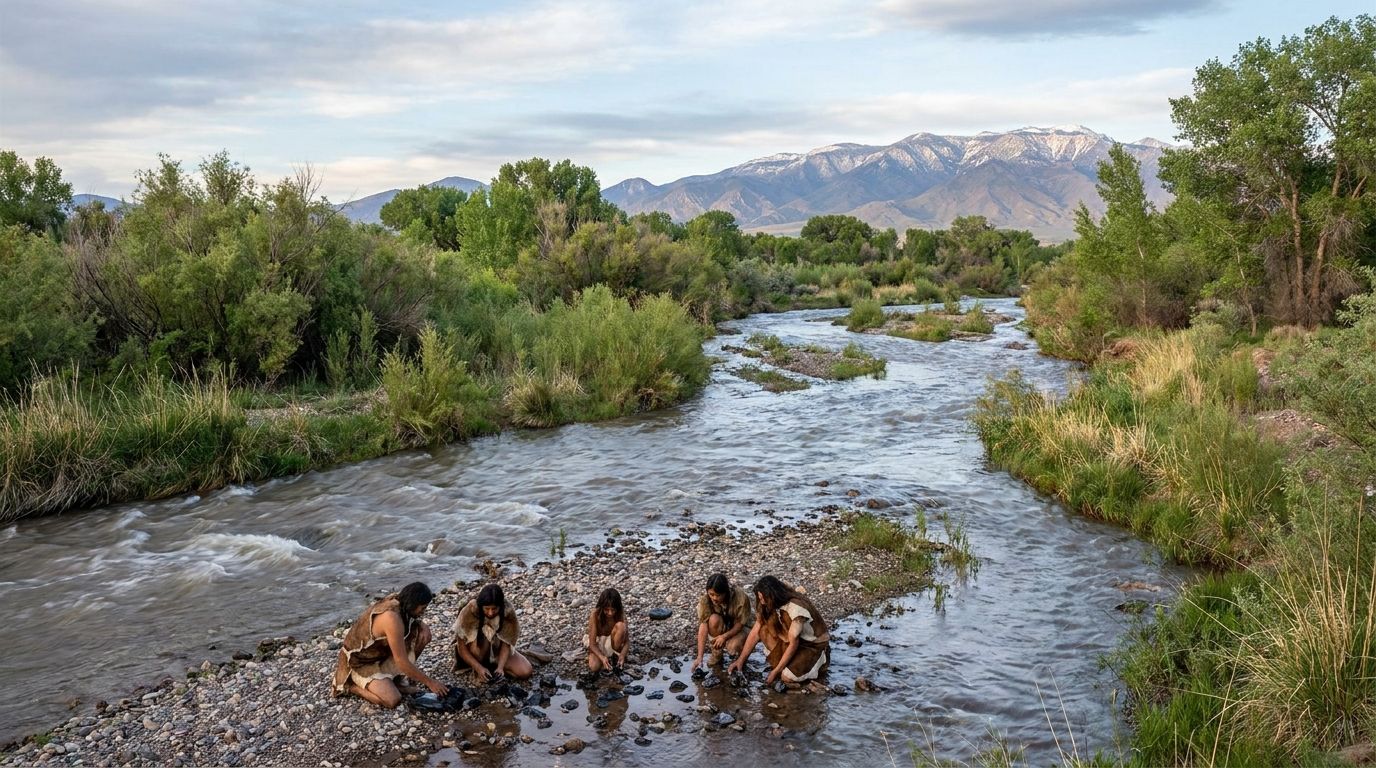
This means two things. First, fresh nodules were continuously being delivered to the Safford area from upstream sources at a higher rate than today. Second, the 111 Ranch Formation sediments were likely more recently deposited and less deeply buried than they are now, meaning large well-preserved nodules were closer to the surface and easier to access.
Shackley’s 2006 paper makes this point explicitly when he notes that Cow Canyon glass is actually more common in the 111 Ranch Formation than in the active Quaternary alluvium of the Gila River today. This suggests that during the high-energy depositional periods that built the 111 Ranch Formation, larger nodules were being transported and deposited in the Safford Valley than what the modern lower-energy river system typically delivers today.
Humans and Safford Valley Obsidian
One of the most striking findings across all four studies is the continuous human use of these glass nodules from the very earliest period of human occupation in North America right through to the historic era.

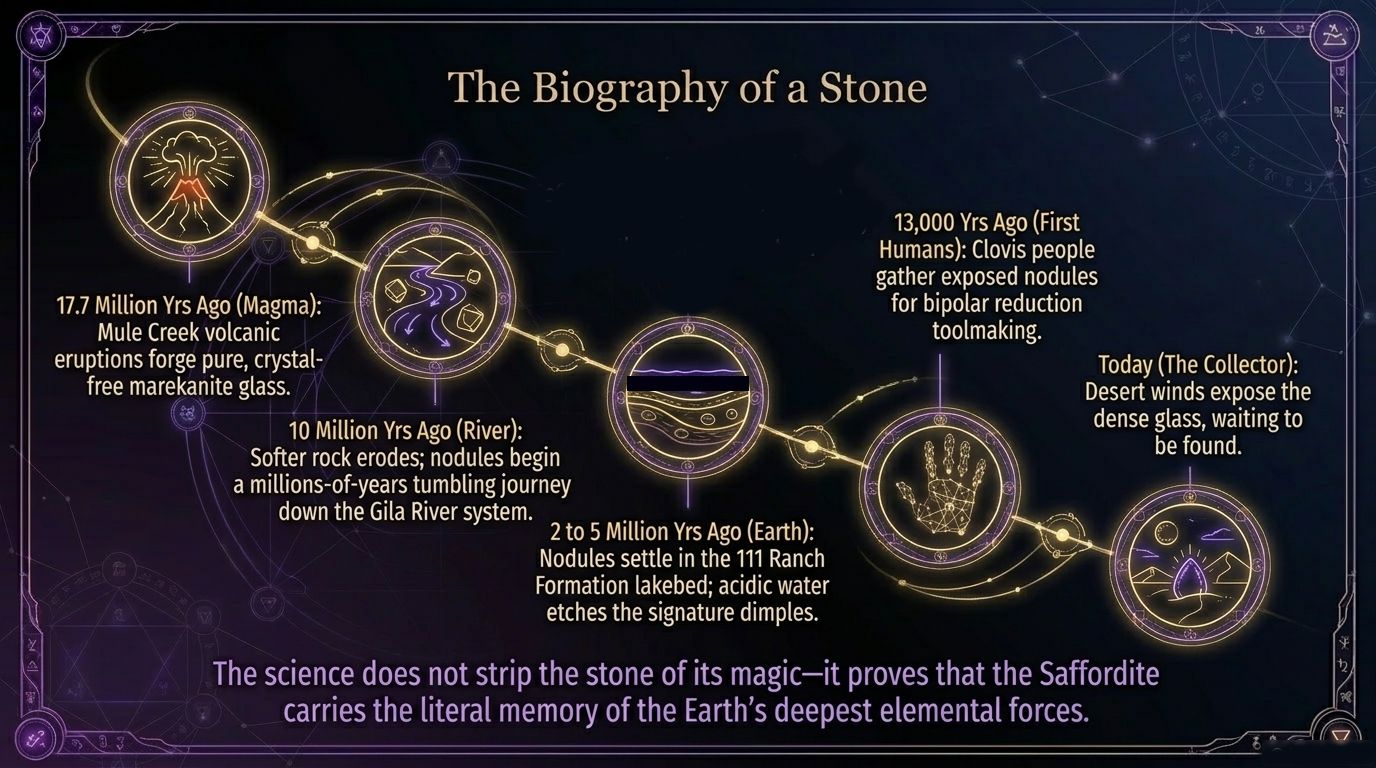
The Clovis people — among the first humans to inhabit North America — were making tools from Cow Canyon glass at the Murray Springs site in southern Arizona at least 13,000 years ago. Those tools were made from nodules roughly 2 inches in diameter, almost certainly collected from river gravels in the Safford area.
From that point forward, through the Archaic period, the Early Agricultural period, the Hohokam and Salado cultural periods, and into the historic era, people living in and around the Safford Valley were continuously collecting glass nodules from the local river gravels and ancient lake bed deposits and making them into tools. The 2013 Epley Site study shows this in the form of projectile points — arrowheads — made from the same glass nodules that Saffordite collectors find today.
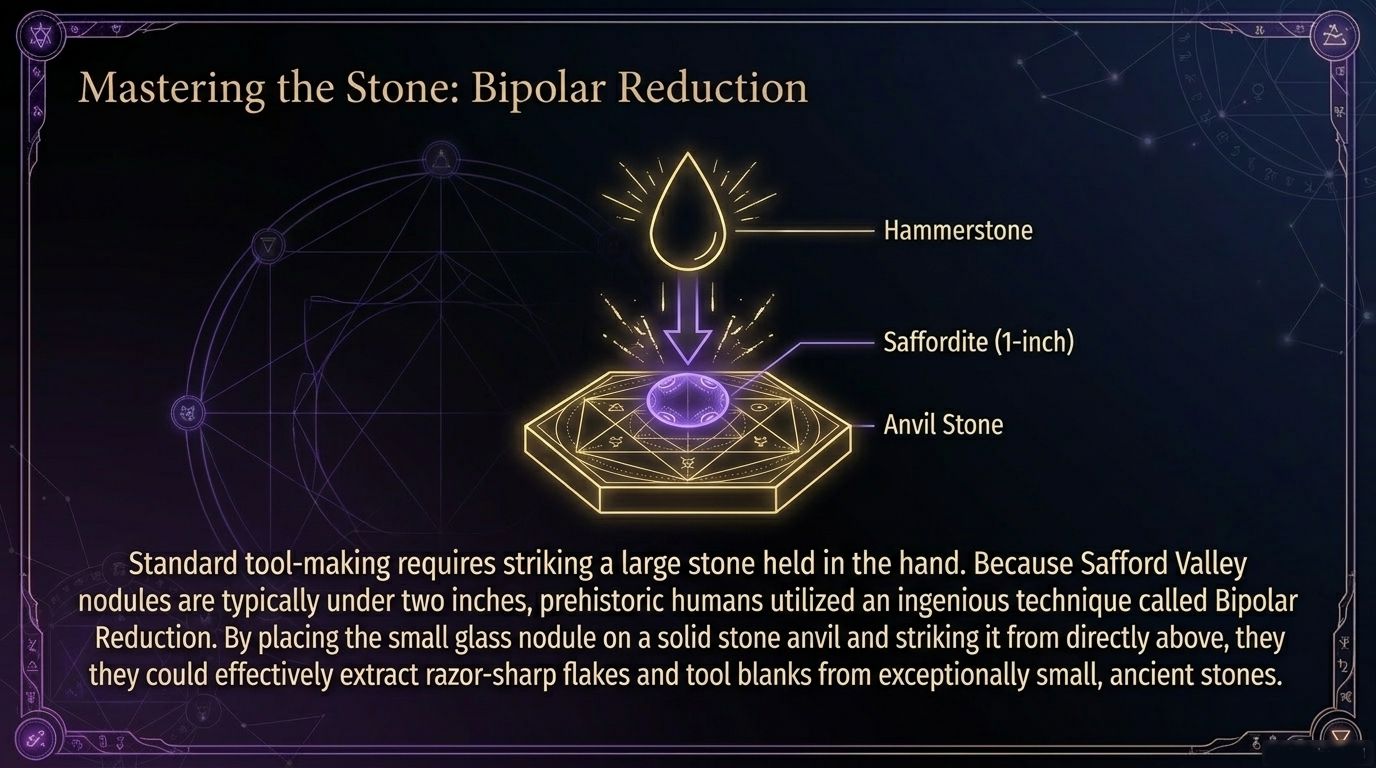
The Clovis people and later prehistoric inhabitants of the Safford area were using a technique called bipolar reduction to work these small nodules. Instead of striking a nodule with a hammerstone in the conventional way — which requires a certain minimum size to hold and work effectively — bipolar reduction involves placing the nodule on an anvil stone and striking it from above. This technique is specifically designed to extract usable flakes and tool blanks from very small nodules, and it works effectively on nodules as small as an inch!
The collecting tradition that modern enthusiasts participate in is therefore not new. It is at least 13,000 years old.
So What Is Saffordite?
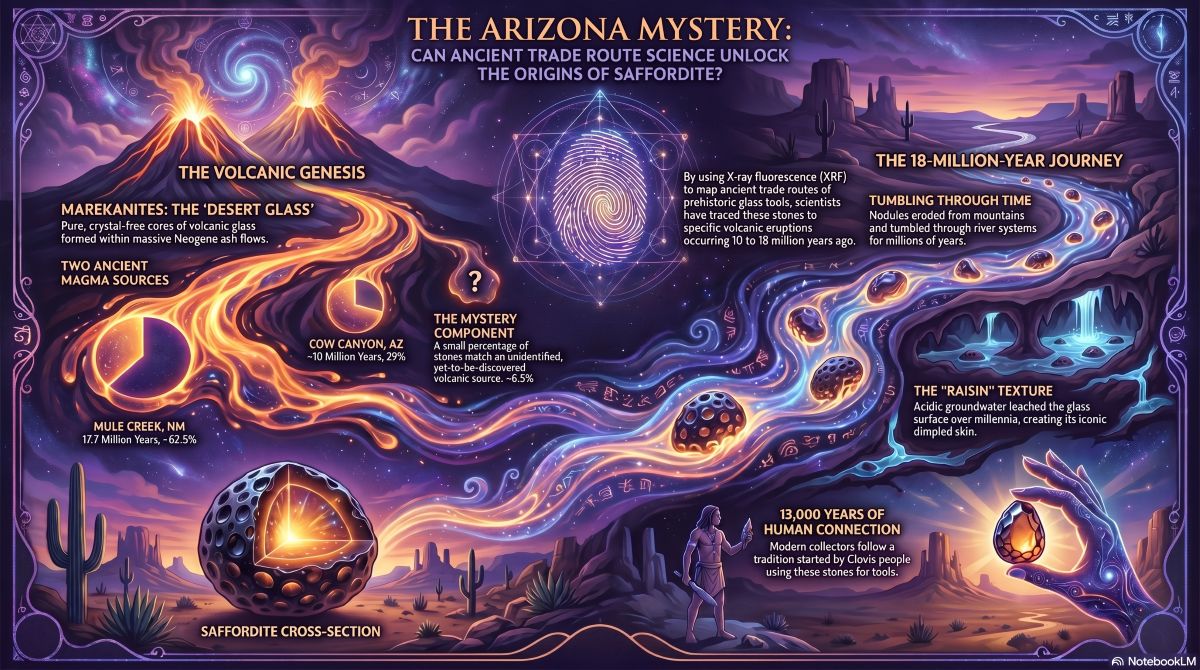
The story of a Saffordite begins 10 to 18 million years ago during the Neogene period. Massive, catastrophic volcanic eruptions ripped through what is now the American Southwest—specifically from vents like the Cow Canyon and Mule Creek flows.
A small additional proportion of uncertain origin — an anomalous chemical signature appearing consistently in Safford Valley studies but not matching any known source — suggests the possibility of at least one additional undiscovered volcanic source contributing to the mix.
These eruptions produced immense oceans of silica-rich lava. When this specific type of magma cools incredibly fast, it doesn’t have time to form a standard crystalline rock structure. Instead, it freezes into an amorphous solid: pure volcanic glass, or obsidian. Deep within these massive ash flows, small, incredibly pure pockets of glass formed. These central cores, free from the impurities that make standard obsidian opaque, are geologically known as marekanites.

A Journey of Millions of Years: Weathering and Etching
So, how did a piece of volcanic glass buried deep in ancient rock get its distinct, alien-looking texture? The answer is time and water.
Over millions of years, the softer volcanic rock surrounding these glass nodules eroded. The freed marekanites were swept up by ancient river systems, relentlessly tumbling down the Gila River network. This brutal journey naturally rounded the stones into the pebble-like shapes we see today.
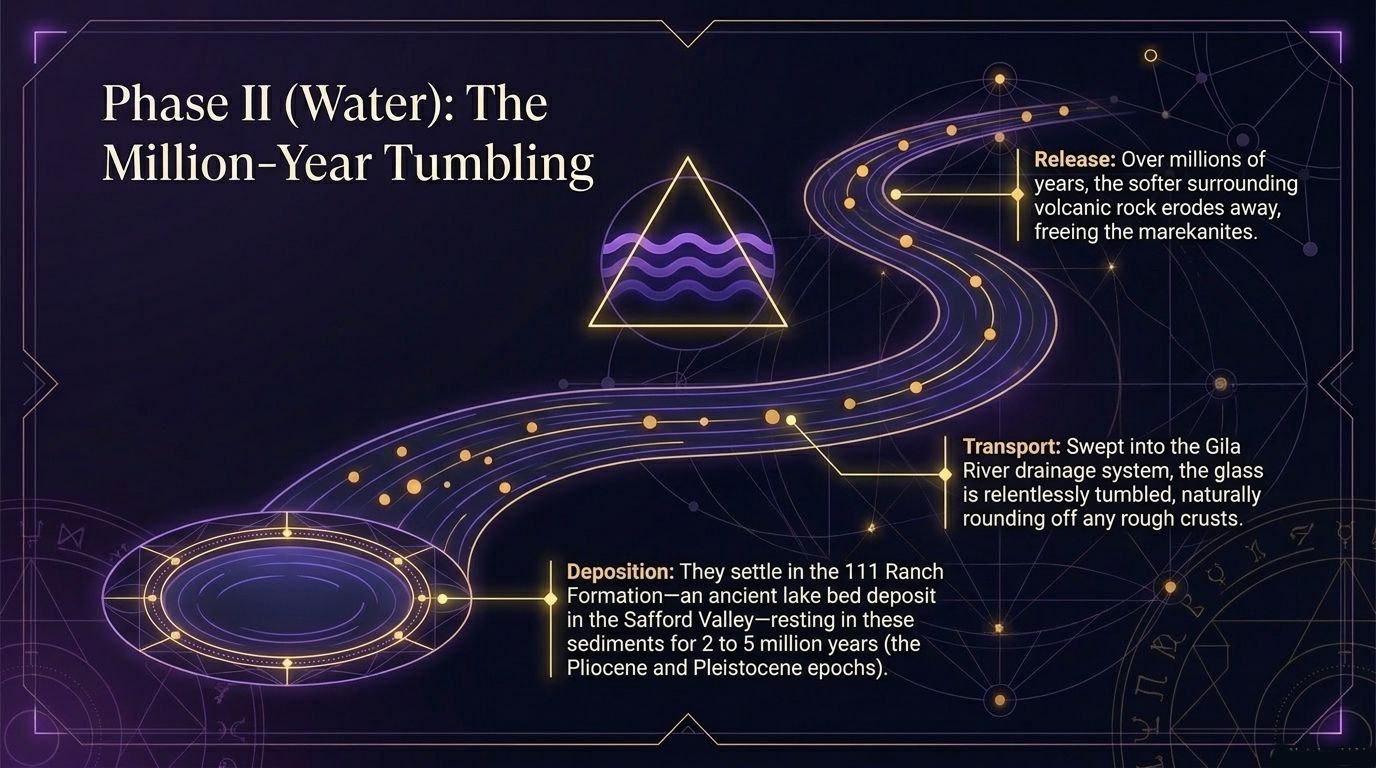
The nodules have accumulated in the ancient 111 Ranch Formation lake bed deposits and in the active Gila River alluvium within the Safford Valley itself.
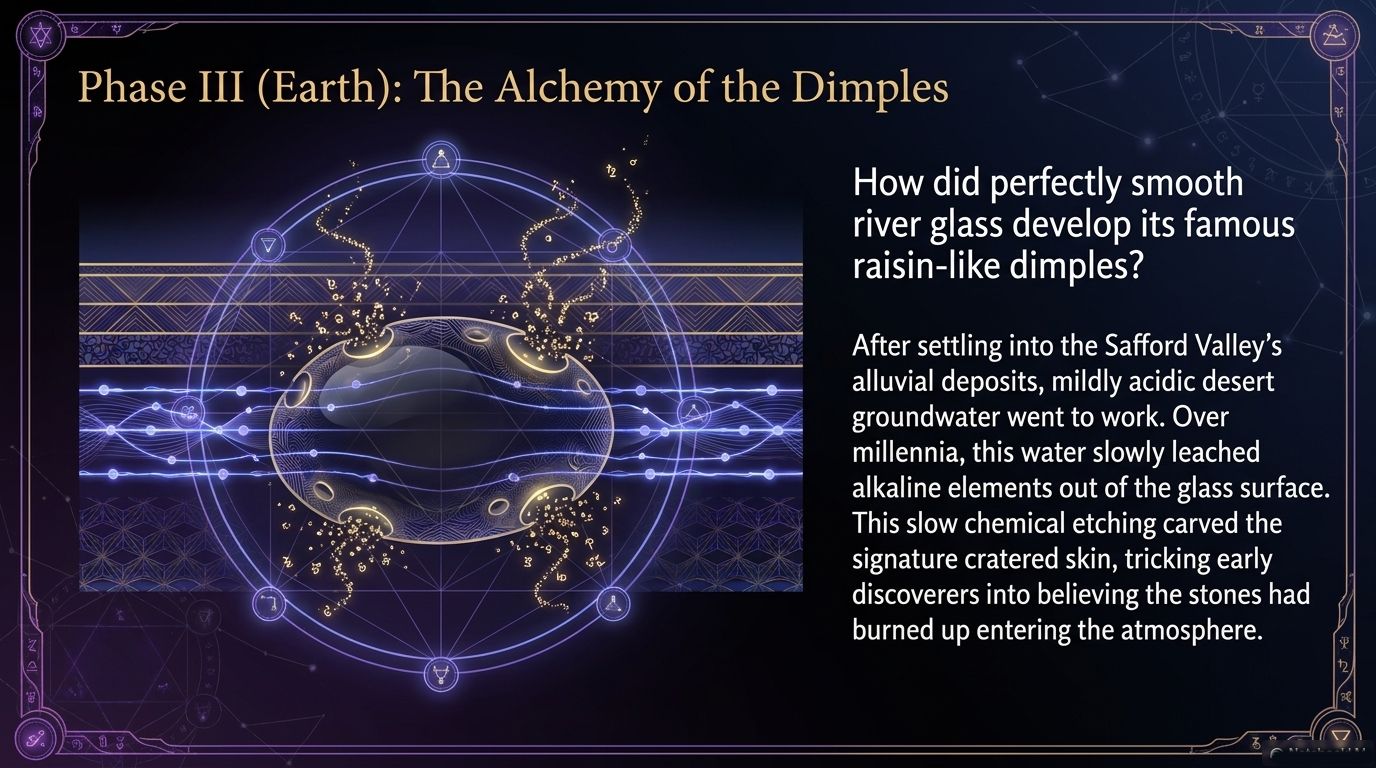
As they settled into alluvial deposits in the desert, mildly acidic groundwater went to work. The water slowly leached alkaline elements out of the glass surface, etching the stones over millennia. This chemical weathering gives Saffordite its signature “raisin-like” dimpled skin and cratered surface, leading early discoverers to mistake it for tektites (meteorite impact glass).
Why We Find Them on the Surface
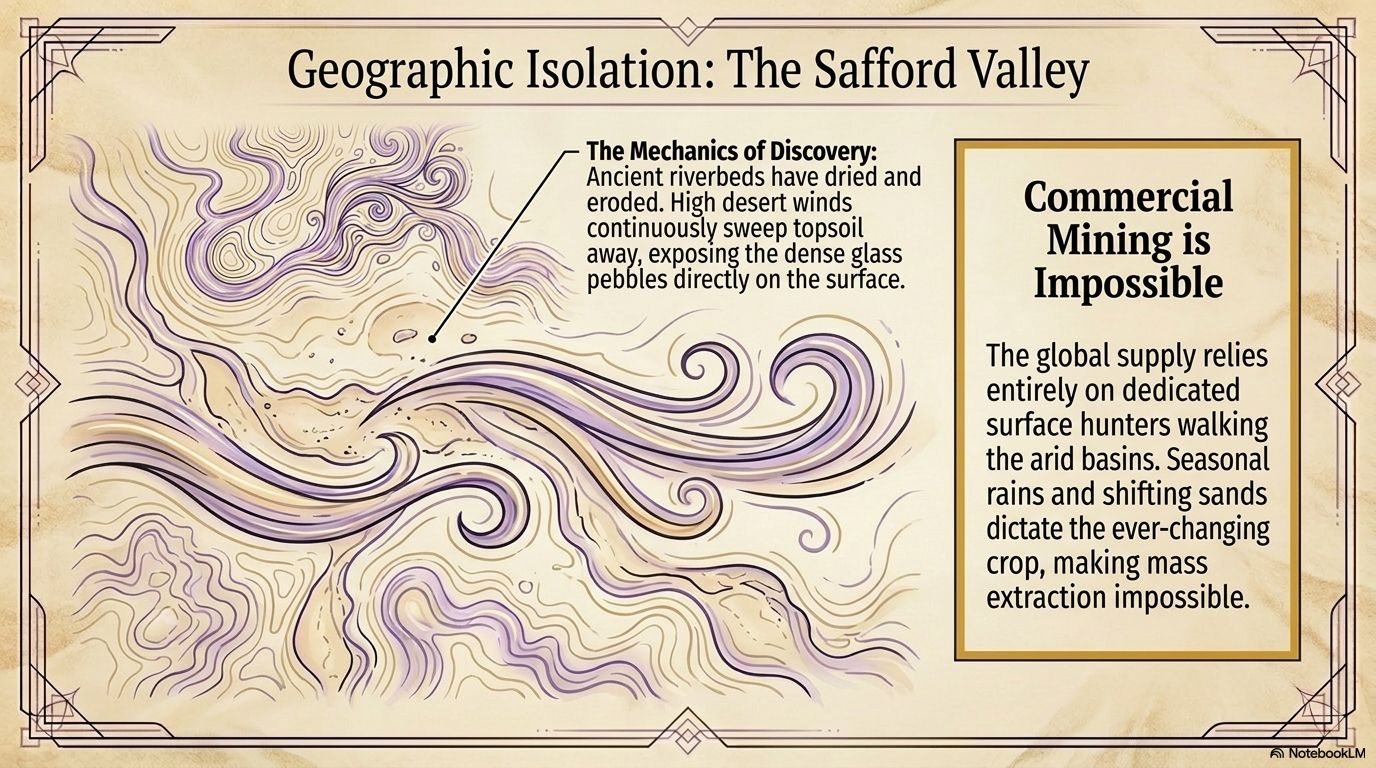
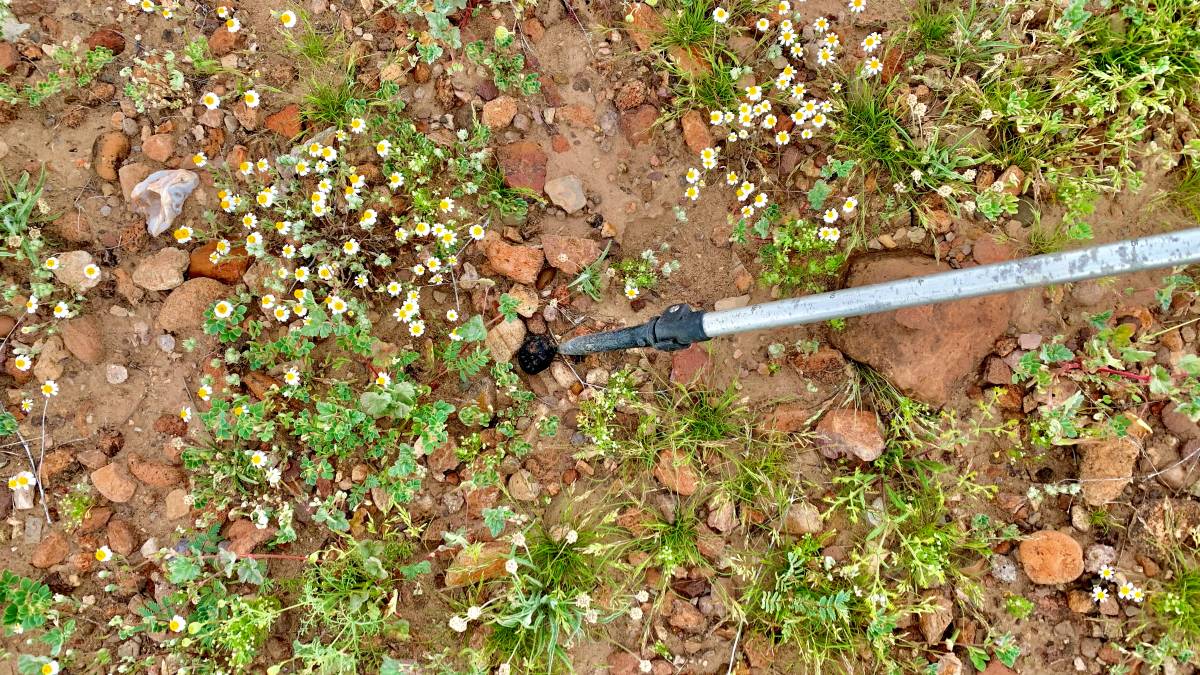
Today, Saffordites are found exclusively scattered across the desert surface in a highly localized area of the Safford Valley in Arizona.
They sit on the surface because the ancient riverbeds that deposited them have long since dried up and eroded. High desert winds continuously sweep away the topsoil, leaving the heavier, dense glass pebbles exposed to the Arizona sun, waiting to be found by dedicated rockhounds.
Interested in finding your own Saffordites? Read our article, Where to Find Saffordite in Arizona
What Would Make This Official?
It is important to be clear about one limitation. Everything described above is strongly supported by the scientific evidence from four separate studies conducted over nearly thirty years. But none of those studies was specifically designed to test Saffordite specimens. They were all studies of prehistoric artifacts found in the Safford region, not of the raw nodules collectors find today.
Nevertheless, we believe that at least some of those artifacts were sourced and shaped from Saffordite nodules as we know them today — collected from the same Gila River gravels and ancient lake bed deposits where Saffordite is found — and therefore originated from either the Cow Canyon volcanic source in eastern Arizona or the Mule Creek volcanic complex in western New Mexico.

The 111 Ranch area is largely located on public lands managed by the Bureau of Land Management (BLM) - it is here where most collectors hunt for Saffordite.
A Final Thought
None of this diminishes what makes Saffordite special.
A stone forged in a volcanic eruption 10 or 18 million years ago, carried by rivers for millions of years, smoothed and shaped by geological forces beyond imagination, collected by the very first Americans 13,000 years ago, lying in an ancient lake bed in the Safford Valley until a collector walked past and noticed its glow — that is a genuinely extraordinary story.
The science does not make Saffordite less remarkable. It makes it more so. It gives the stone a specific biography stretching back millions of years, connects it to the deep geological history of Arizona, and links the people who collect it today to an unbroken human tradition reaching back to the ice age.
We strongly believe the answer to where Saffordite comes from has been waiting in the scientific literature for years. It is time for the collecting community to know it.
Experience the Light of the Desert
Ready to experience the high-frequency energy of the desert for yourself? Browse our hand-selected, authentic collection of Arizona Saffordites. Every stone is unique, ethically sourced from the Safford region, and waiting to find its keeper.