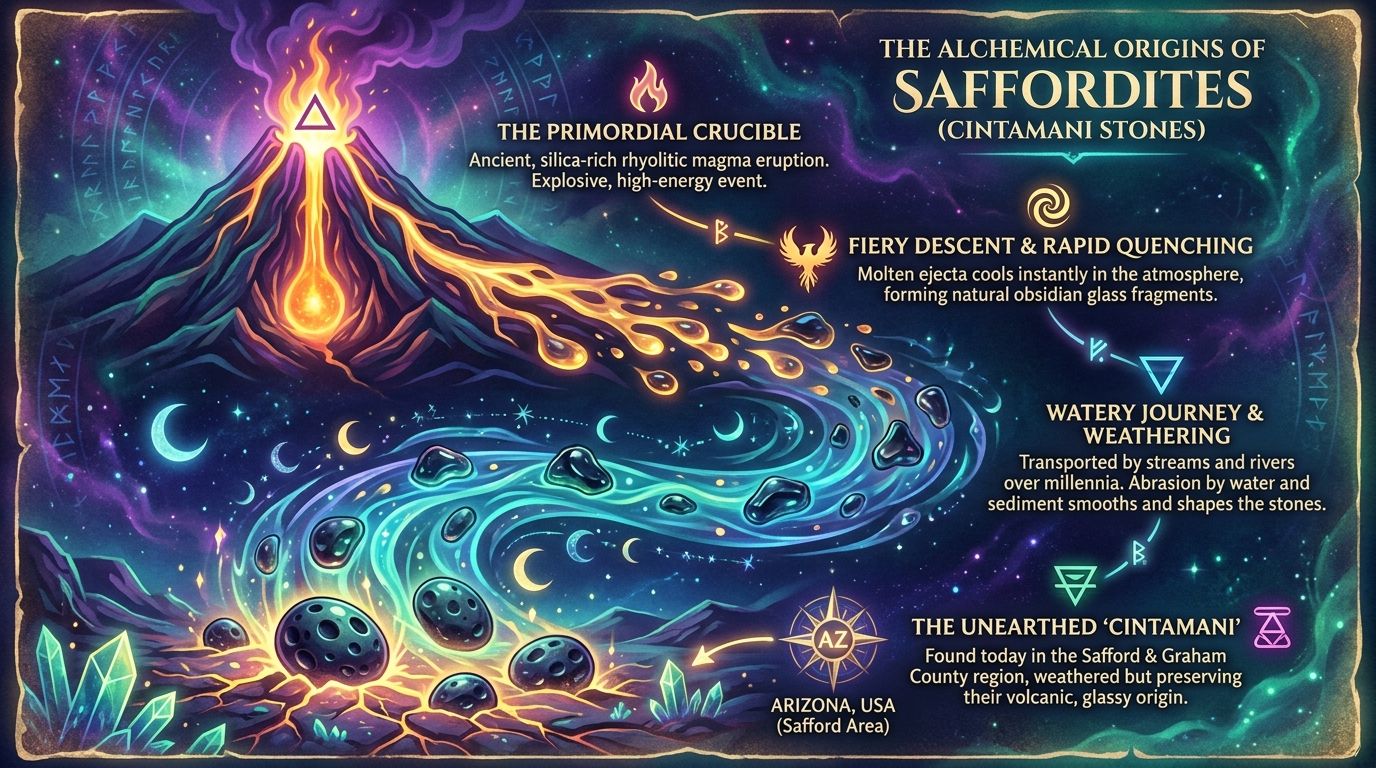
Few stones on Earth carry as much geological intrigue and mythological weight as the Saffordite. Found scattered across a specific, rugged expanse of the Arizona desert, these dark, deeply pitted stones have captured the imaginations of rockhounds, geologists, and spiritual seekers alike.
But where did they truly come from?
As independent field hunters and specialists, our approach is simple: we combine peer-reviewed scientific data with firsthand physical experience on the desert floor to retrace these stones to their true genesis. Every claim on this page is anchored either in published geology or in what we have personally observed in the field — and we tell you which is which.
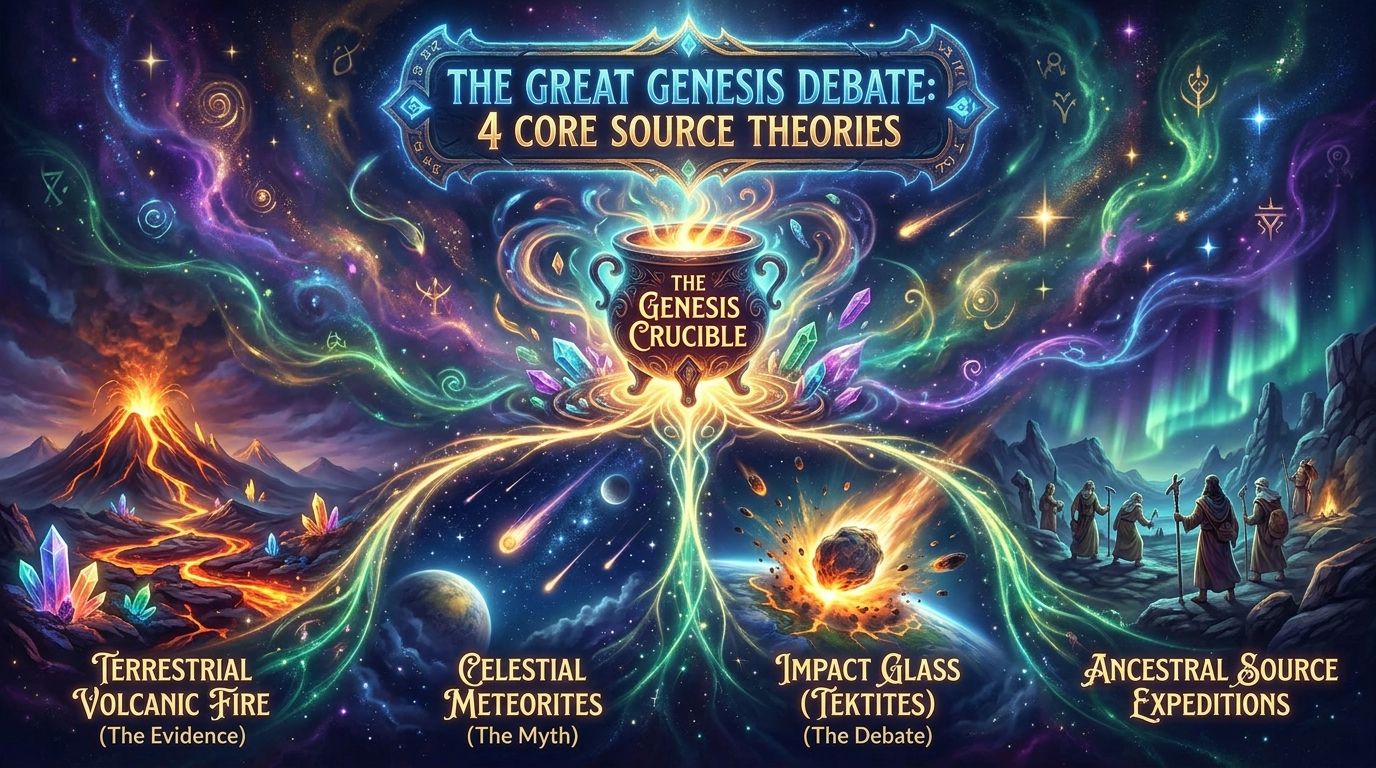
The Great Genesis Debate: 4 Core Source Theories
To understand the Saffordite, one must understand the competing theories surrounding its birth. The world of stone collection generally splits into four camps regarding how these unique specimens came to rest in the desert gravels.
1. The Terrestrial Volcanic Fire Theory (The Scientific Evidence)
The most rigorous geological evidence points down, not up. Saffordites are marekanite nodules — glass cores that survived as the surrounding perlite hydrated and crumbled away over millions of years. Published research traces the regional volcanic glass to two ancient source complexes: Cow Canyon in Greenlee County, Arizona (roughly 10 million years old) and the Mule Creek complex just across the New Mexico line (roughly 17.7 million years old). From there, the Gila River drainage carried the surviving nodules downstream, where many came to rest in the ancient lake beds of the 111 Ranch Formation. This long journey of fire, water, and time explains their intense surface pitting (cupules) and their signature smoky-gray or light-amber translucency.
Dive deeper into the hard science, the cooling structures, and the mineral data in our comprehensive guide: The Arizona Mystery: Can Ancient Trade Route Science Unlock the Origins of Saffordite?
2. The Celestial Meteorite & Cintamani Theory (The Sacred Myth)
Parallel to the scientific record lies a rich tapestry of esoteric history — one whose roots reach back far beyond the Saffordite’s modern discovery in the Arizona desert.
The Cintamani itself is ancient. In Hindu and Buddhist tradition, the Chintamani is the wish-fulfilling jewel — the Eastern counterpart to the philosopher’s stone. It appears in the hands of bodhisattvas, rides on the back of the Wind Horse across Tibetan prayer flags, and is woven into legends of Shambhala, the hidden kingdom. Lore holds that fragments of the stone passed through the hands of history’s great rulers, and in the 1920s, the painter-mystic Nicholas Roerich famously carried a purported Cintamani fragment on his expeditions across Central Asia. Notably, the older Roerich-era lore tied the stone’s origin to the constellation Orion — not Sirius.
The Sirius connection is the modern chapter of the story. Beginning in the 2010s, contemporary spiritual communities identified Saffordite as the physical Cintamani — stones said to have originated in the Sirius star system and arrived on Earth in the deep past. In this telling, the stones carry the pure light frequency of Sirius, the brightest star in our night sky and one with its own formidable esoteric pedigree: the ancient Egyptians revered it as Sopdet, herald of the Nile’s life-giving flood, and mystery traditions from the Dogon of Mali to Western esotericism have long treated Sirius as a source of spiritual transmission. Proponents work with Saffordites as anchoring stones — jewels that ground celestial frequency into the Earth plane and into the energy field of the keeper.
How did a wish-fulfilling jewel from Himalayan legend become attached to a volcanic glass from the Safford Valley? And where does ancient allegory end and modern internet folklore begin? That is precisely the trail we follow in our full analysis: The Leatherpetal, the Serpent, and the Saffordite Stone: A Desert Map to the Treasure Within
3. The Impact Glass / Tektite Debate (Future Article Slot)
Somewhere between earth and sky lies the tektite question. Some collectors point to the Saffordite’s rounded forms and scattered distribution as tektite-like — reminiscent of terrestrial rock melted by a massive meteorite impact, launched skyward, and rained back down across the landscape. It’s an understandable comparison, and one worth examining carefully rather than dismissing.
Status: Field research in progress. Our upcoming comparative analysis will put Saffordites side by side with verified global tektites — Moldavite, Indochinites, and others — and examine where the resemblance holds and where it breaks down.
4. Retracing the Ancestral Sources (Expedition Active)
Saffordites do not stay put. Millions of years of flash floods, tectonic shifts, and desert erosion have carried these stones far from their birthplaces. The published literature points to Cow Canyon and Mule Creek as the primary candidates — but a citation on a page is not the same as boots on the ground.
Our quest is field verification: mapping the alluvial dispersion trails, reading the topography of the land, and physically retracing the stones upstream toward their source points, with XRF comparison against the published reference data as the final confirmation step.
Status: Expedition active. Future field logs and mapping data will be published here as we close in on the source.
Fortunately, you do not have to wait for our expeditions. You can find your own Saffordites! Follow our guide: Where to Find Saffordite in Arizona.
Why the Origin Changes Everything
Understanding the exact genesis of a Saffordite isn’t just an academic exercise — it is the key to unlocking its value and utility.
Through the lens of geological rarity, their survival across millions of years of intense desert weathering makes them a marvel of natural preservation. For those who work with them alongside meteorites or other crystals, knowing their true volcanic grounding baseline allows you to construct balanced, stable energetic pairings.
Here is how we see it: the science tells us where these stones came from. The lore tells us why people have treasured them for thousands of years. Both stories are real, and both are worth knowing — they simply answer different questions.
Explore the pathways above. Follow the science, follow the lore, read our field logs — and discover which chapter of the Saffordite’s journey speaks to you.