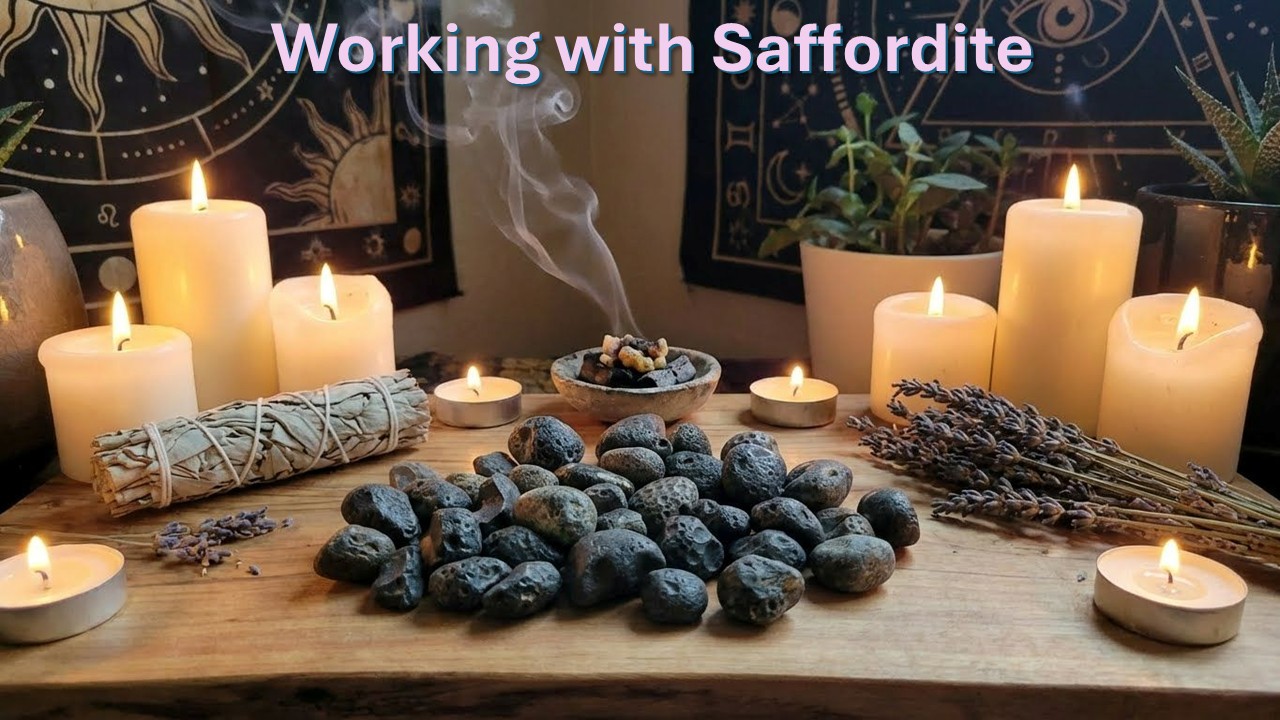
So you found your stone — or it found you.
Maybe you walked the dry washes of the Safford Valley and spotted that telltale dimpled glint among the gravel. Maybe a hand-selected nodule arrived in your mailbox, wrapped and waiting. Either way, you now hold something extraordinary: a piece of volcanic glass up to 18 million years old, shaped by rivers that no longer flow, chosen by the first humans in North America.
Now what?
A Saffordite can live two lives. It can rest in a display case as a museum piece — and given everything we know about saffordite value, that is a perfectly honorable fate. Or it can become a working stone: a daily tool for grounding, meditation, energy work, and intention.
This guide covers the second life. What follows is a summary of every legitimate way practitioners work with Saffordite, organized by practice — from five-minute daily habits to full ceremonial use. Whether you approach this stone through belief, curiosity, or simple appreciation for deep time, there is a practice here for you. In future posts, we will delve deeper into these practices.
If you’re new to Saffordite, start with the origins story and the collector’s guide first. For everyone else: let’s put your stone to work.
Before You Begin: Cleansing and Programming Your Saffordite
Every practice in this guide assumes a cleansed, programmed stone. Take five minutes to do this properly — and to avoid one common mistake that can permanently damage your specimen.
How to cleanse Saffordite safely
Saffordite is volcanic glass: chemically stable, water-safe, and sun-tolerant. You can cleanse it with:
- Smoke — pass the stone through the smoke of cedar, sage, or incense.
- Moonlight — set it on a windowsill or outdoors overnight.
- Sound — a singing bowl, bell, or tuning fork held near the stone.
- Running water — a brief rinse under cool water, then pat dry.
One warning: never scrub Saffordite with salt or abrasives. The dimpled, cratered skin on your stone took millions of years of groundwater etching to form. It cannot be repaired, and as we covered in the collector’s guide, an intact surface is a major driver of a specimen’s value. Protecting the skin protects both the stone’s character and your investment. Gentle methods only.
How to program your Saffordite
Saffordite carries the Cintamani tradition — the wish-fulfilling jewel of Buddhist and Hindu lore. Programming a wish-fulfilling stone is the most natural act in the world:
- Cleanse the stone.
- Hold it in both hands at heart level.
- State your intention — out loud or in writing — in plain, present-tense language.
- Carry the stone or place it where the work will happen.
That’s it. Re-program whenever your intention changes, cleansing between.
Signature Practice: The Deep-Time Meditation
This is the one practice that belongs to Saffordite alone — because no other stone on the market has a biography this specific, this documented, and this long. Use it as your foundation. Ten minutes, one stone, eyes closed.
Settle. Sit comfortably. Hold your Saffordite in your cupped hands or against your solar plexus. Feel its weight and its dimpled skin. Take three slow breaths.
The fire. Travel back 17.7 million years. A volcanic complex erupts in what will one day be called Mule Creek. Silica-rich magma cools so fast that no crystal can form. The stone in your hands is born in that instant — pure glass, frozen fire. Breathe with that image.
The river. Ages pass. The glass tumbles down ancient rivers, mile after mile, century after century, its edges rounding, its surface polishing. Everything rough is slowly carried away. Breathe with the water.
The burial. The stone settles into the bed of a vast desert lake. Darkness. Stillness. Millions of years of patient transformation, as mineral-rich groundwater etches the cratered skin you can feel beneath your fingertips right now. Breathe with the earth.
The light. Desert winds strip the soil away. The stone surfaces under an Arizona sun. A human hand — perhaps yours, perhaps a Clovis hunter’s, thirteen thousand years before you — picks it up. Breathe with that continuity.
Return. You are holding compressed deep time. Whatever weighs on you today is, by this stone’s measure, a single heartbeat. Let the stone hold the long view so you don’t have to. Open your eyes.
Practitioners report that this meditation produces the deep, almost geological sense of grounding that Saffordite is known for. It also does something subtler: it makes the stone’s story yours.
Meditation & Inner Work
Beyond the Deep-Time Meditation, Saffordite supports the full range of contemplative practice.
1. Palm-stone meditation. The simplest practice of all. Hold the stone, close your eyes, and let the texture be your anchor. When the mind wanders, return attention to the dimples under your thumb. Saffordite’s river-polished, crater-skinned surface is unusually tactile — many practitioners find it easier to anchor on than any worry-smooth tumbled stone.
2. Third eye placement. Lie down and rest a flat specimen on your brow for ten to twenty minutes. Practitioners use this for insight work, intuition, and accessing what the metaphysical tradition calls the akashic records. Translucent stones are favored here.
3. Candle gazing. Hold a translucent Saffordite between your eye and a candle flame (or the low dawn sun) and gaze through it. The light-amber, smoky, or gray glow is the “light of the desert” made literal — a moving meditation on the stone’s volcanic birth.
4. Breathwork anchor. During box breathing, holotropic work, or any intensive breath practice, grip a Saffordite in one hand. Its grounding character acts as a tether, letting you go deep without drifting.
5. Sacred-number meditation. Work with a set of nine stones — one per breath cycle, chakra, or spoken intention — moving a stone from one pile to another as you complete each round. This old counting structure turns an abstract practice into something physical and satisfying. Read more about our Sacred Cycle of Numbers Meditation.
6. Mala-style counting. Keep a pouch of small nodules and draw them one at a time through your fingers during mantra repetition, the way mala beads are used. Small 1–2-gram stones are ideal for this.
Energy Work & Crystal Grids
Saffordite occupies a rare position in energy work: practitioners consistently describe it as deeply grounding and high-frequency at the same time — a stone that anchors rather than elevates, yet hums with the intensity of its volcanic origin. That dual nature makes it unusually versatile.
7. Root and earth star anchoring. Place a stone between or just below the feet during energy sessions. This is Saffordite’s home position: connecting the body to the deep earth, the stone spent millions of years inside.
8. The column layout. Because of its dual nature, Saffordite can hold both ends of a full-body layout — one stone at the root or feet, another at the crown — creating a single energetic column from earth to sky. Most stones can do one job or the other; Saffordite does both.
9. Crystal grids. Saffordite serves two grid roles. As the center stone, it acts as the Cintamani — the wish-fulfilling jewel at the heart of the pattern, holding your programmed intention. As anchor stones, four nodules at the corners ground the entire grid. Five stones give you a complete working grid: four corners and a center.
10. The Sacred Quartet. Saffordite works well with the family of three legendary natural glasses — Moldavite, Indochinite, and Libyan Desert Glass — that practitioners work as a complete energetic system, with Saffordite as the grounding capstone. Pairing your Saffordite with any of its three siblings creates a circuit between earth energy and cosmic energy.
11. Merkaba work. During merkaba visualization, hold Saffordite as the grounding pole — the fixed point around which the light-body geometry spins. Its stability is exactly what this demanding practice requires.
Everyday Carry: Saffordite on the Body
Not every practice needs an altar. Some of the most devoted Saffordite users simply carry their stones — and the nodule’s naturally rounded, river-tumbled shape makes it the rare specimen stone that is pocket-perfect without any cutting or polishing.
12. Pocket talisman. The classic everyday use. For empaths, sensitives, and anyone overstimulated by crowds, screens, or noise, a Saffordite in the pocket is a portable piece of deep ground. Reach for it when the day gets loud.
13. Worry stone. Run your thumb over the cratered dimples whenever stress rises. Unlike a manufactured worry stone, every crater on a Saffordite is unique — your thumb will learn your stone’s particular landscape within days.
14. Wire-wrapped pendant. Wearing Saffordite keeps it in your field all day. Placement matters: over the heart for emotional steadiness, at the throat for grounded communication, longer over the solar plexus for personal power. Flat and banded specimens take a wire wrap beautifully.
15. Travel stone. Carry a Saffordite through flights, moves, and life transitions. There is a quiet symmetry in it: this stone spent millions of years traveling down the Gila River drainage to reach its resting place. It knows something about journeys.
16. Practitioner’s session stone. Massage therapists, Reiki practitioners, and body workers keep a Saffordite in a pocket during sessions — a personal ground wire while working in other people’s energy.
Sleep & Dream Work
17. Under-pillow dream stone. Place a Saffordite under your pillow or inside the pillowcase to encourage vivid dreams and stronger recall. Start with one night at a time and see how you respond.
18. Dream incubation. Before sleep, hold the stone and ask a single clear question. On waking, pick the stone up again before you move or speak, and write down whatever is present. The stone bookends the practice — same object, both sides of sleep.
19. Lucid and astral anchor. For practitioners doing lucid dreaming or astral work, Saffordite serves as a tether: its grounding character makes deep journeys feel safer and the return smoother.
20. The nightstand option. An honest note: some people find direct contact with Saffordite too activating for sleep — a common experience with high-frequency stones. If your dreams become too intense, move the stone from under the pillow to the nightstand. Same presence, gentler dose. Let your own experience calibrate the distance.
Home, Land & the Planetary Grid
A working stone doesn’t have to live in your pocket. Saffordite has a long tradition of holding space.
21. Altar centerpiece. Place your finest specimen at the heart of a home altar — the jewel-in-the-lotus arrangement we explored in the Leatherpetal article, built physically: the Cintamani resting at the center, supported by whatever holds meaning for you.
22. Four-corner room gridding. Place one stone in each corner of a bedroom, meditation room, or healing space to anchor and steady the entire room. (Four small stones do this job as well as four large ones.)
23. Desk and workspace stone. Keep a Saffordite beside your keyboard. Touch it between tasks, calls, or difficult emails — a three-second grounding ritual, dozens of times a day.
24. Threshold guardian. Place a stone at the front door. Obsidian has held the protective threshold role across cultures for thousands of years; Saffordite, the most refined obsidian on earth, inherits it naturally.
25. Earth gridding and stone burial. Within the worldwide Cintamani community, there is an established practice of burying stones at meaningful locations — sacred sites, energy lines, places of conflict or healing — as conscious gifts to the planetary grid. Many practitioners consider Saffordite as an American Cintamani, especially suited to grid work on this continent. This practice deserves far more space than we can give it here; a dedicated guide is coming. For now, know that some stones are meant to be kept — and some are meant to be planted.
26. Garden and land blessing. A gentler version of the same idea: return one stone to the earth in your own garden. After 18 million years of fire, water, and burial, there is something deeply right about completing the circle on land you love.
Divination & Reflective Practice
27. Scrying. Here, Saffordite touches the oldest documented use of volcanic glass on Earth. Obsidian mirrors were sacred tools in Mesoamerica, and polished obsidian has served scryers across centuries of recorded history. Saffordite offers something those black mirrors never could: translucency. Gaze into a dark specimen by candlelight, or through a translucent one, letting the eye soften, and impressions rise. No other stone connects modern scrying so directly to humanity’s ancient relationship with volcanic glass — the same relationship the Clovis people began in this very valley 13,000 years ago.
28. Casting stones. Keep three or more small Saffordites in a pouch. Assign meanings — yes, no, wait — or simply draw one each morning as the day’s focus stone. Over time, you will come to know each stone individually by its weight and skin.
29. Journaling companion. Hold a Saffordite in your non-writing hand during free-writing or shadow work. Practitioners describe it as steadying the process — keeping the pen honest and the writer grounded while difficult material surfaces.
30. Pendulum. A small wire-wrapped nodule on a chain makes a naturally weighted pendulum with the added presence of deep time behind every swing.
Ceremonial & Relational Use
Some of the most powerful Saffordite practices involve more than one person — or mark the moments that matter most.
Gifting and “finding its keeper.” Within the Cintamani tradition, these stones are often given rather than kept — passed deliberately to the person who needs them. If a stone in your collection keeps bringing someone to mind, that may be information. A gifted Saffordite carries its whole 18-million-year biography to its new keeper.
Group meditation circles. Give each participant in a meditation circle one stone from the same batch. Every stone in the circle formed in the same eruptions, traveled the same rivers, and rested in the same ancient lake bed — a literal shared origin, held in a circle of hands.
Seasonal charging rituals. Cleanse and recharge your stones by the elements of their own story: a rinse in moving water for the river years, a night on bare earth for the burial, a day under the open sun for the desert surfacing, moonlight for everything in between. The stone’s biography is the ritual calendar.
Rites of passage and memorial. A Saffordite given at a birth, a graduation, a wedding, or a death carries a perspective no other gift can: this stone existed before our species, and it will exist long after us. For memorial use especially, that deep-time presence offers a strange and genuine comfort — grief held against the scale of 18 million years.
A Note on Elixirs
A frequent question: can Saffordite be used to make gem water? Volcanic glass is chemically inert and water-stable, but we recommend the indirect method regardless — place the stone beside a sealed glass of water rather than in it. This protects the irreplaceable cratered skin from repeated soaking and handling, and it is simply the careful way to treat a finite, hand-collected stone. The intention does the work; the stone does not need to be submerged.
The Display Case or the Working Stone?
Here is the honest answer: it isn’t a choice. Most serious Saffordite keepers end up with both — display specimens whose banding or translucency is too fine to risk in a pocket, and working stones that ride along through daily life, sleep under pillows, anchor grids, and occasionally get planted in the earth.
The display case preserves the stone’s past. Working with it gives the stone a future — a continuation of the same human relationship that began when a Clovis hunter picked one of these nodules out of the river gravel thirteen thousand years ago and decided it was worth keeping.
The supply is finite. The practices are endless.
Experience the Light of the Desert
Ready to begin working with Saffordite? Browse our hand-selected, authentic collection of Arizona Saffordites — from single meditation stones to complete grid and practice sets. Every stone is unique, ethically sourced from the Safford region, and waiting to find its keeper.
For the geological and archaeological story behind every practice in this guide, see “The Arizona Mystery: Can Ancient Trade Route Science Unlock the Origins of Saffordite?” and “Why Saffordite is One of the World’s Most Valuable Stones” at SafforditesUnearthed.com.
To read how we use Saffordite in meditation, read our Meditation with Saffordite article.